
Style Files: The Eccentric Old Lady in an English Manor
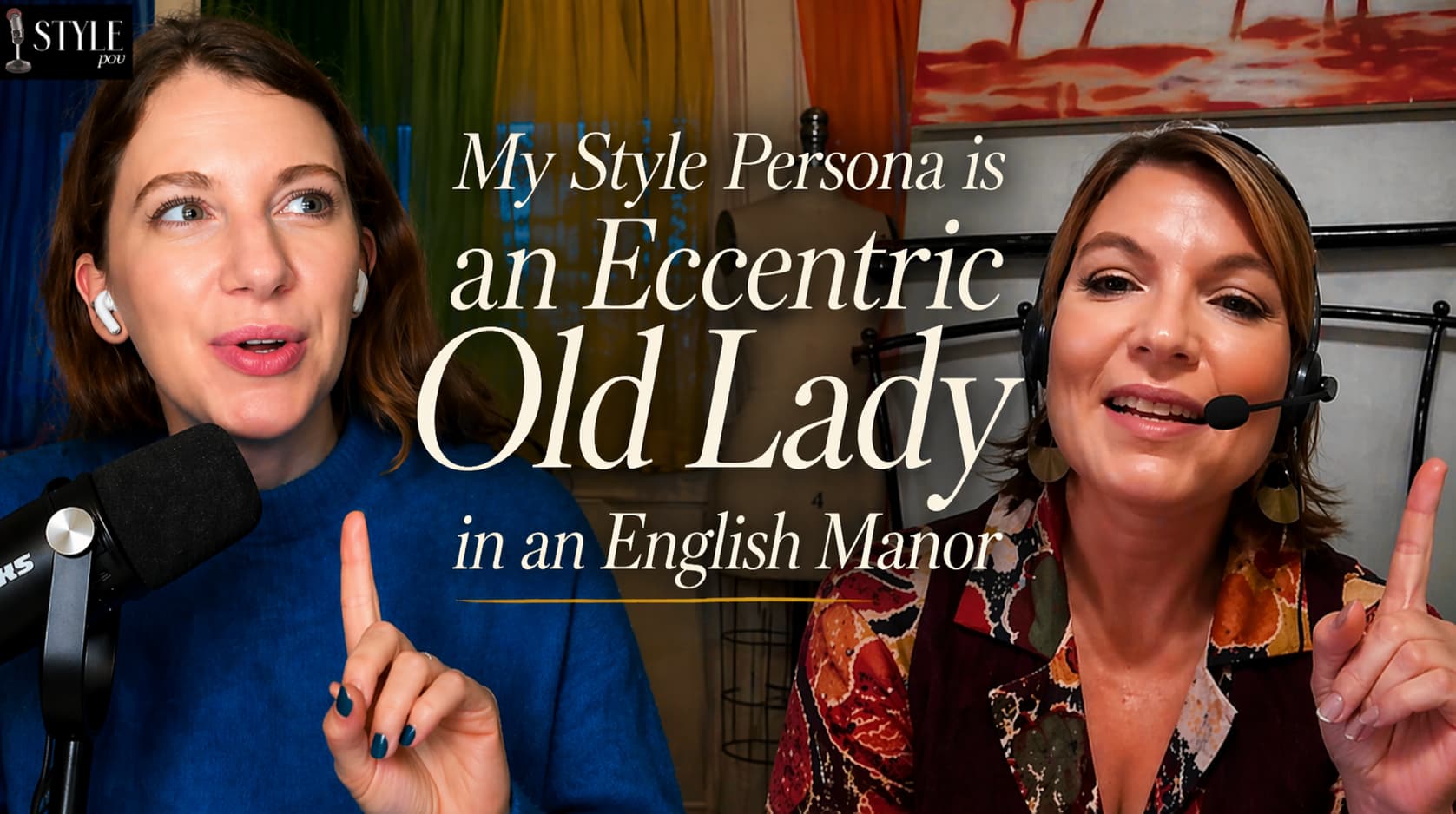
Welcome back to Style Files, the part of the show where real listeners share their real style journeys, the awkward beginnings, the breakthroughs, and everything in between. In this episode, I sit down with Valerie, whose story begins with years of discomfort around clothes, limited access to new styles, and a deep fear of never quite getting the fit right.
We talk through the slow shift that changed everything. From trying to force herself into trends that never felt like home to discovering how style could become a form of identity and storytelling. Valerie shares how one blazer sparked a turning point, how meeting her first style influences expanded her perspective, and how the pandemic quietly reshaped the way she saw her wardrobe and herself.
We also explore her current style vision, one that feels playful, intentional, and a little bit mischievous. Think old manor house energy, a narrative approach to dressing, and the confidence to create a persona instead of chasing rigid systems. From capsule wardrobes to the importance of community, Valerie opens up about what it really means to evolve your style with honesty and imagination.
If you have ever struggled with fit, access, or feeling like your wardrobe did not reflect who you are inside, this conversation will feel like both permission and inspiration. Let’s get into it.
Listen to it:
Watch it:
Timestamps
01:07 – Valerie’s limited access to fashion
03:12 – The fear of not getting a perfect fit
06:42 – The blazer that started it all
08:41 – Meeting her first influenzers
12:51 – No shame in overdressing
15:19 – Big life change
17:05 – Finding personal style in the pandemic
22:33 – Style through line
25:57 – The why behind the structure
29:20– Style systems vs creating a persona
33:44 – Style POV on capsule wardrobes
37:20 – The goal with capsule wardrobes
41:55 – Having a style community
46:42 – Finding the next style evolution phase
References:
Countess Image: https://www.artnet.com/artists/bruce-weber/the-duchess-of-devonshire-feeding-her-chickens-at-zvjzSVgfWXvUq7CFDKD4ig2
Transcript
(auto-generated)
Gabrielle: [00:00:00] Welcome back to Style Files, the part of the show where I talk to real listeners about their real style journeys, all about what worked for them, what doesn’t, and the honest process of figuring it all out.
Today I’m talking with Valerie. Her journey starts with a lot of discomfort around clothes and fit. Years of trying to make things work, an access problem to new stores and new styles, and then a slow shift into seeing style as an identity in storytelling. And her new point of view involves an old manor house, a touch of mischief, and maybe even a stable boy.
Let’s get into it.
Hi, Valerie, thank you so much for coming on the Style Files. I’m so excited to talk all about your personal style today. Do you want to start with where your personal style journey started?
Valerie: Yes, and thank you for having me. I’m so excited also because I mean, I am pretty much a regular gal here. I will start from the beginning in the sense that I’m French Canadian, so that’s the accent. Coming from Northern Ontario in the eighties, so very remote area [00:01:00] and everything. And coming from blue-collar, middle-class, four siblings.
We didn’t have access in the sense that it was Sears catalog shopping. We didn’t have a Walmart. So there was definitely like the hand-me-downs. The ‘it’s too tight’ because obviously, my sister was two years older than me, but I soon catch up, right? But my mom didn’t realize.
During those times, you know, I was watching Fashion Television with Jeanne Beker. I was watching like those, Gone with the Wind, you know, fantasy thing. And like my princesses weren’t like Disney princesses. It was like Sisi, empress of Austria. So there was a lot of fantasy and a lot of those teenage crisis ‘what I’m going to wear today for school because nothing fit me and my parents are pretty much like [00:02:00] no nonsense people.’
Like, ‘Is it clean? Does it fit? No wear and tear. Yeah. Like you’re good to go, girl.’
Gabrielle: So there’s these two things, like this fantasy element, this Gone with the Wind, your own version of your Disney princess and then the like, fashionist functional, you wear whatever’s in your closet and you get to it. So there are two opposite ends, right?
Valerie: Yes. That’s it. And there’s no reconciliation, right?
Gabrielle: Yeah. Especially at like, what, 14? You’re like, ‘How do I merge these?’
Valerie: Yeah, that’s it. And then I move, I move to suburban Ontario, still remote, still Northern Ontario. 150,000 population. I’m starting to have money. I study history. I have a master’s in history, like not in costume, but still it’s prevalent, right? Because of all those movies that I was watching and everything.
Gabrielle: Yeah.
Valerie: But I have a little more access and so what [00:03:00] I really realize, looking back like and still today, it’s all the fit, right?
Gabrielle: Oh yeah.
Valerie: I was kind of traumatized about clothing not fitting me till like 15, you know? Now, I’m shopping and I have some disposable money, even when I was a student at university. It was like, ‘Is it fitting me well? Like, am I comfortable and fitting?’
It was also the silhouette, like proportion, like for me, fit is that include all those notion and also looking back, I was watching Fashion Television. I knew like Alexander McQueen. I was purchasing those magazine, you know, those Glimmer, Vogue and so on.
But it was still a fantasy self. It was still like, ‘This is so pretty, I wish.’ But I don’t even know where to start to look for those things.
Gabrielle: Well it sounds like even though you had more [00:04:00] money or slightly more access, you weren’t, you know, exposed to the Alexander McQueen store, you weren’t exposed to the tailoring that is involved in that level where you’re just like, the fit is so.
I mean, he’s an amazing example because he got a start in tailoring. So his tailoring is perfection. And if you want to talk about good fit, he’s a great example of that. So it’s clear like you are honing in on people who are like, I know how to tailor and I know how to make clothes be in perfect harmony with the body, no matter their silhouette, no matter their shape.
So fit is really important. How were you feeling about clothes on your body at that time? Like, was it getting better from when you were 14 or was it?
Valerie: Yes, definitely. When I look back, I still see like, what I’m doing today, right? Like that person is not different.
She’s not elevated. Right? I didn’t have a clear direction of where my style was going. I remember, Canadian people will know about Le Château. Le [00:05:00] Château was the “it” store for like teenage young adult. And I remember , I made this purchase. It was a coat, a suede coat, and it was like, very fitted everything. And it, it was like those, I guess it was the reproduction of a Halston, you know, smoker.
Gabrielle: Oh, beautiful.
Valerie: Yeah.
Gabrielle: He also knew how to cut different, completely different approach than McQueen. But boy does he know how to cut. I mean, yeah.
Valerie: So the Le Château was the “it” store at that time. So it was like the beginning of 2000. Okay. No. Online shopping don’t exist. Like you have to go to a real store.
Gabrielle: Yeah. And back then, right. It’s like I forget about that. I’m like, oh yeah. I couldn’t just like order it on Nordstrom.com.
Valerie: No, that’s it. And you’re aware what you see. That’s it. And again, limited access because it’s Northern Ontario, it’s still remote area. I remember I left from Montreal and I’m [00:06:00] still living in Montreal. Montreal for people again, who don’t know, it’s the second largest city in Canada, mostly francophone in the province of Quebec.
It’s kind of a little hub, like fashion hub, right? So before moving to Montreal to do my PhD that I never finished. I went shopping for, I don’t know what reason, and I went to this new store, it was American Eagle.
Gabrielle: Okay.
Valerie: You know, like, it was like, yeah.
Gabrielle: I remember American Eagle. It was, it was a big deal. So I get it. You were excited, I’m sure. Talk us through this experience.
Valerie: And I purchased this blazer. It is my first blazer ever. Now I have a collection. Just, you know.
Gabrielle: Okay. It star it started the trend.
Valerie: It started the trend. And I remember I paid $100 for that blazer, and it was like, yeah, I paid more for my coats, like the suede [00:07:00] coat and so on.
But I mean, for a coat, you usually spend more, right? I remember like, oh my God, can I spend a hundred dollars on a blazer? And I remember I wore it and I was like, ‘this is perfect.’ Like, it just fit perfectly. I remember I went back to my friend and I was like, I got to wear that blazer like forever. And I still have that blazer. That blazer’s 25 years old.
Gabrielle: Worth the a hundred bucks. Man, that’s been a workhorse piece, I mean.
Valerie: It’s a little tired. I wear less these days, but , it’s still in my wardrobe. Like it’s my archives, here we go.
Gabrielle: I love that. Okay.
Valerie: But for me, again, like it’s not clear where I’m going with my style, but it’s definitely like high moment and I want to recreate that, right? I want to recreate that feeling where you wear that garment and that garment can change the whole outfit. And then I moved to Montreal and I [00:08:00] meet a lot of people. I have two separate group. It’s one of my friend and, she’s still my best friend now and she was doing those trading clothing. We used to call it switch.
Gabrielle: Clothing swaps.
Valerie: Clothing swaps. Thank you. Yeah. We used to call it switch and pitch.
Gabrielle: I like that too.
Valerie: I mean, that was in 2005, 2006. The whole like, recycling, thrifting is not a thing. She’s 10 years older than me, like, so I was 25, she was 35.
She was elsewhere in her life. But because of her, I meet this group of people and all our friends are in the entertainment business. They are in those at costume, you know, department. Some are hat makers and some are starting their design line of clothing.
So, a couple of them were designers or worked for designers. [00:09:00] So I met this girl, so of course, I mean, those people have like way more knowledge of clothing than I have of the small clothing business. Because in Montreal, there’s a little hub of very local designer, mostly woman-owned, small boutique. Those clothing brand are by definition like…
Gabrielle: Like small community brands.
Valerie: Like, yeah, no. But like local conscientious, like. They don’t have the stamp, but that’s what they are, right?
Gabrielle: They’re probably all made in the same town and Yeah. The small runs, they’re not producing a thousand of things and sending it all over.
Valerie: That’s right. Two collection a year, 15 to 20 pieces per collection, you know? So with her and her group of friend who are pretty much all in their thirties. She told me like, you know what, for this year resolution, what I want is that my style project what I want people to see.
She was like, I will declutter [00:10:00] my wardrobe and my wardrobe will be exclusively of like thrifted, and local designer. And I was like, what? You can do that?
Gabrielle: That’s an option?
Valerie: Yeah, that’s it. Like you can ask more than fit from your clothes. I was like, kind of surprised but it still didn’t click because she had a very particular style, like very, metal goth, adjacent, witchy all black, and with her friends who look like designers and working in the clothing industry and the garment, you know, costume department and so on, like, it is part of your job, right?
So that personal style can be also applied to me. I thought about it, but again, no real direction because for me, I thought, that’s their job. Like, you know.
Gabrielle: But this, they’re in industry. Yeah. So they get to use fashion this way. I’m [00:11:00] just like a regular person. So maybe I can’t have a conceptual design behind my personal style.
Valerie: That’s it. So that’s one group that really like help me understand that business and the whole concept. When I drop out of PhD.
Gabrielle: Hey, it’s a long program. You got a lot out of it, I’m sure.
Valerie: I didn’t know what to do. It wasn’t history. I start teaching, didn’t really work out. So start working at a call center and I worked there for 12 years. It was fun. Even though like call center is difficult. It’s a very difficult.
Gabrielle: Yeah.
Valerie: Hats off to anyone at a call center.
Gabrielle: I can imagine.
Valerie: But it was fun and there was a lot of South American people, American. A lot of North African immigrant are second generation, like Italians, Greek, and so on. And, it wasn’t customer facing, so we didn’t really have any dress code. So people were pretty much dressing whatever, but [00:12:00] those women or those girls or those people, like of my age, they were dressing up.
Like they didn’t care. We are French Canadian, but Canadian general. We’re polite. We are really reserved, right? But those people were like, oh my God, Valerie, this is so cute. Like, what are you wearing? They weren’t shy. They were very expressive. They were really taken care of. You know…
Gabrielle: They’re expressive.
Valerie: Yeah. Sometimes it was like, are you going out? And they were like, no, you know, it’s sunny. It’s like, why not dress up?
Gabrielle: It’s like a community that kind of opened up your eyes that anyone can have access to this. This doesn’t have to be just for going out or special occasions or, that one event you have coming up. You can have a personal style anytime.
Valerie: Yeah. There’s no shame in overdressing. I hear people sometimes like, oh, I shouldn’t wear that. It’s not special enough. Like no. Wear it, right?
Gabrielle: Wear the [00:13:00] clothes. Enjoy them. They don’t get enjoyment by living in your closet. They get enjoyment by being out in the world and being appreciated. That’s what designers want. They don’t want you to be precious with your things and archive them in perfectly room temperature-controlled closets.
Valerie: That’s it.
Gabrielle: How did that affect your style at that time? How were you approaching style at that time? Well, because you’re getting some influences that are helping you see style as something more than just clothes on a body that need to function for the day. How was your style right then?
Valerie: Like I don’t own any sneaker, like sneaker. It’s not in my wardrobe. I don’t own any sweatshirts or jogging pants.
Like I don’t own leggings. I really enjoy Law Roach’s interpretation of like style is because they say it’s a structure, right? He’s an architect.
Gabrielle: Yeah.
Valerie: So what is the base? What is the foundation of your style? If I look back, even during those times, my base is like [00:14:00] structured garment. I don’t like sweatshirts. I think I look like a marshmallow, like a big cloud. So, structured clothing, pleated, pleated trousers, you know?
I am mostly a straight jeans person, and shoes are usually like laced up. It can be flat. I’m not a high heel person, but you know, square toe.
Gabrielle: You like a lot of angles, it sounds like, and you like those straight, structured pieces, and now I see why you probably had fit problems because those are the hardest to find to fit you perfectly.
You know, if you’re a stretch jersey person, you can find a lot of options that fit you. They’re made to conform to anybody. But if you want a really nice tailored pant or a really nice tailored blouse or shirt, it’s hard to find those off the rack. So I’m sure there was a journey to kind of experience, okay, clothes as function, I’m appreciating fit, but now I’m seeing what clothes can really do. And is [00:15:00] this kind of the moment where you’re starting to merge fit and expression? Or when does that happen?
Valerie: Well, I always, like expression in the sense that I was in the school band. I play classical flute and then trumpet, and I always love makeup. I always love perfume and then I got pregnant.
As strange as might sound like, yes, you cannot dress yourself like you used to. But you cannot, wear makeup and perfume. Not that you cannot, but like you wear in perfume, you’re taking your baby and it’s like smelling perfume. Yeah. And not a baby. So you’re just like, oh no, I don’t want to do that. And again.
Gabrielle: Yeah.
Valerie: And makeup is the same. Like you putting it.
Gabrielle: You’re getting it on the baby. Yeah.
Valerie: It’s kind of disgusting.
Gabrielle: You simplify a little bit because you’re like, I just have to take care of this little, little baby.
Valerie: Yeah. Yes. But, in Canada, we have the chance to have a year of maternity leave paid by the government.
Gabrielle: That’s amazing.
Valerie: Right. But as soon as I could [00:16:00] fit in, like regular clothes, I did because again, like I was, I couldn’t wear my makeup, I couldn’t wear my perfume. So for me, suddenly getting dressed was I important. It was like starting my day. And like I hear people, like, for one year I stayed in my PJs and leggings, and it’s like, no, no.
Two months afterwards, I had my jeans on and my husband was walking, coming back from work, and he was like, ‘You went out?’ And I was like, no. Like, you’re going out. No, no. personal time. You know, it’s like getting back, reclaiming my body. So that also was a factor in the sense that now dressing up was more important.
But again, I couldn’t find what I wanted, right? So my style really, like, came full and became what I wanted was, [00:17:00] strangely enough, 2020 with the pandemic.
Gabrielle: I think 2020 was a precipice for a lot of people’s style journeys. It was like the style systems were coming in. We had time to kind of just like mull things over. Everyone was wearing sweats, and we were all getting a little sick of it. So it’s like we were looking for answers. I think everyone was looking for answers.
Valerie: But not only that, it was access because nobody could go shopping. Right?
Gabrielle: Oh yeah.
Valerie: So yeah. In Canada, it’s a big country, but with 38 million people, so it costs a lot. It’s not great, there’s no reason why you want to tap into that market in the sense that it’s small. It costs a lot. But again, with 2020, we might as well ship everywhere, right? That’s where I discovered those new but vintage-inspired clothing, and very like German, like polished and like Lena Hoschek and so on. And that was like, oh, now I can buy [00:18:00] what I want.
Gabrielle: WhatI want.
Valerie: Yeah. Also, I started painting. So there’s that music factor, but there’s also that painting. I paint with acrylic. And it’s all about the layer, right? So I have the base, right?
So if we go back to the style architecture, it’s like you have the base, but now you can actually, like, dress up your house, right? Like, now you can elevate it. Now you can add to it. When people are talking about style and, you know, obviously, I am a maximalist, like I’m not a minimalist.
People are like, ‘Oh, yeah, but you know, during summer or during winter, layering can be more difficult.’ For me, layering is not necessarily like putting a blazer on, and you know, a button-down or a waistcoat and so on. It can be like print, colors, textures, and everything.
I like to, of course, think about my style persona, who is my [00:19:00] eccentric old lady in her English countryside manor, and could only keep her stable boy, because, you know.
Gabrielle: She’s running out of money.
Valerie: Are gone money. Yeah.
Gabrielle: Yeah. I love this. I love this.
Valerie: The glorious days are gone, and she doesn’t really like horses, but you know, she…
Gabrielle: But she keeps the stable boy around. You know?
Valerie: Yeah. That’s it.
Gabrielle: Okay, wait, I want to, I want to back up because for people who are not familiar with Law Roach’s style architect, from what I understand and from my research, he kind of is all about like the world building.
It’s a very encompassing look. There’s no formulas. It’s all tailored to the person. It’s very much about like, what event are you going to? Yep. What’s your psychology? Build up from structure, and then we’re going to add all these nuanced details that make it fit for you. Yeah. Did you create this, eccentric lady in the English manner based on that? Or where did that kind of come from? Or you were just always connected to that?
Valerie: That’s, I was always connected to [00:20:00] that.
Gabrielle: Okay.
Valerie: The weird thing is because I had my old lady eccentrically. I think it’s a little of a great expectation, you know?
Gabrielle: Okay.
Valerie: I always love a blazer. Another anecdote I remember at my old job, at the call center. It was like women’s month and this communication specialist, coordinator, whatever, she was like, okay, we need to put something on our website which woman really affect us or, you know, that we really look up to.
And I laugh at her and I was like, I won’t put my mother, because most of people were putting their mother and I love my mother. And she was like, ‘Put whatever, Valerie. Just put something.’
Gabrielle: She wants everyone to participate.
Valerie: Yeah. Everyone to participate in everything and no one wanted. So, and it was like, me, the woman that I look up to is the queen. And she was like, oh, really? Like Queen Elizabeth, too. And I was like, yeah. And she was like, [00:21:00] What? And I was like, well, she’s living in castles. Yeah. That she had servants. I read that somewhere, but I was like, she drank one glass of red wine per day.
Gabrielle: I mean, sounds like she has a pretty good life.
Valerie: Yeah, that’s right. She had jewelry, she have a horse and I always remember like those pictures of the queen in her Balmoral, Scottish. I love imagery like that, you know, and the queen always had a personal touch, right? If she’s going to a country, like she’s having this little brooch and that represent that country, and she will always wear a color. Of course, I want to head to toe like her. That’s very integral.
But for me, that’s interesting in the sense that there’s purpose, there’s a story, so again, like all those things build that story. The queen can be very formal.
Gabrielle: When she needs to be. Yeah.
Valerie: When she needs to be, right? [00:22:00] You can see her with her rubbers boots at, not cottage, but country houses and have like very lived-in clothes and everything. I remember when you talked about like, volume, right? Like you can have a different volume with your style. So like, it’s not because you have a very distinctive style that you cannot bring it to different occasions.
Yeah, it totally disappears if you’re going hiking or you’re going to the city or, you know, a special event and so on, but it’s just that.
Gabrielle: That through line of like, you have it, that’s right. When you’re hiking or you have it when you’re at a gala, whatever you need to do, there’s something about you that connects back to that home base, back to that eccentric lady or back to your architecture of, this is my world. This is how I want to express it.
It doesn’t matter if I’m, you know, picking up my kids from daycare or if I’m going to a work event, I’m still finding those pieces of me to express myself.
Valerie: Yeah. Okay.
Gabrielle: So I want to ask you a [00:23:00] question.Here we have fit, we have a great style system. We have this kind of overarching concept that you’re working with. You said you like blazers, and I know there’s a lot of advice about like, here’s what we wear with a blazer. This is the outfit formula you need to do. Here’s the top 10 ways to wear a blazer. This is the blazer that’s in for this season.
Did you ever have a phase where you tried that? How was your experience with that type of content? Because I know if you search blazers, you’re going to get a lot of it.
Valerie: I don’t own any white t-shirt also.
Gabrielle: Okay, good. I don’t own, so not your vibe. Good.
Valerie: Not my vibe. But I did consume and I did research because…
Gabrielle: Everyone does, right?
Valerie: Yeah. No, but you also need to know, before this, the construction, right? Like you still need to be aware of and try it and to see that it doesn’t apply to you. So for me, I never had like [00:24:00] that oversized blazer. This is not happening. I’m 5’ 3”. I’m like, I just feel lost and everything.
Gabrielle: You knew it was not your fit match?
Valerie: No. And I discovered before 2020, Smythe Blazer, which is very fitted, very close to the body. They usually run smaller than usual. And I remember, I think my first Smythe blazer was like purchased in 2017 and I was just like, this is it. This is,
Gabrielle: This is my moment. I found it. Holy grail.
Valerie: Yeah. So I have a couple of a J.Crew blazer because they’re also good for petite people. I have a short torso and everything. But it’s my blazer, like if I can spend all my money on them, if money wasn’t an object, I would.
Gabrielle: Yeah, I get it. Good tailoring is like, once you experience it and you look inside and you see the lining and all the little details, and then if you ever take it apart, you’re like, oh my gosh, I understand why this costs [00:25:00] so much, because there are so many steps to make a blazer. So many.
Valerie: Yeah and you could look like crap and put a blazer on and everything sings. It is like that big final, the orchestra, right?
Gabrielle: Oh yes. It’s the moment.
Valerie: It’s the moment. Sometimes that’s it, right? When I’m going out and about I have my eccentric lady. And yes, I’m more like thirties, forties inspired. Like I’m not vintage, like seventies or sixties. Nothing wrong, but okay. That’s not where I fall.
Gabrielle: So what attracted you to the thirties and forties?
Valerie: The structure.
Gabrielle: What words would you use? The structure. Yeah.
Valerie: The structure. I really love knickerbockers. I love the Oxford. I love the small paperboy hat. I like those messengers bag, like everything’s square. Everything is like close to the body because of course, you know, depression and then
Gabrielle: Yeah. Actually women’s structure had a lot more structure visually, and they say [00:26:00] that it’s subconsciously tied to the women needed to be able to carry more weight.
They go from these very delicate like flouncy dresses and like straight, 1920s vibes to having more structure in their clothes and visually to like be able to carry the, the weight that was going on. More was expected of them. They had to show up.
Valerie: Yeah. And they needed to go to work. They needed to go and not like a secretary or teachers.
Gabrielle: No.
Valerie: They needed to go to like the factory making bombs and so on. It’s also that the female now wear a lot of male clothing, right? Like we do male clothing for the female. And like I do wear dress, I do wear skirts. I like, You know, fifties shape.
Gabrielle: But I wouldn’t say you go delicate. Maybe you don’t like the delicate, no. Yeah. That, that was not a word that was on your radar. Delicate or flouncy. You like structure and shape and something that holds itself up, right?
Valerie: But it’s also like bringing both the [00:27:00] female and the male, like, you know. Like, have a very tailored blazer with a waistcoat and that flowy skirt. For me it’s like having that dandy style, but still, and I love a dandy style. Those are more Victorian, but I find also like some Victorian inspiring thing trickle to the thirties and forties.
Gabrielle: Like, and the dandy was also the male version, so they were having Yeah. The same thing. It was male and female kind of influencing that. Yeah. Yeah. If you went Victorian female, that would be a completely different thing. So it’s like, this dandyism has that same kind of structure with some interest to it, with some. quirkiness to it, if you will.
Valerie: Yeah. They weren’t shy of showing all the colors and, you know. It was like a peacock moment for boys.
Gabrielle: Yeah.
Valerie: So I’m also, of course, with my history background, like those are elements that speak to me, right. Like I can, without being too on the nose, I like to take element [00:28:00] and just bringing, and sometimes, most of the people won’t pick on it like they won’t. But I know.
Gabrielle: You know, that’s the same thing with the designer. When a designer designs a collection, you include all these little details from your inspiration and no one knows they exist, but you’re like, I know that thread was chosen for this reason, or, I know it’s cut like this to reference this. So it doesn’t have to be, the other person understands that it’s dandyism and thirties in silhouettes.
So let’s go back. It’s 2020. Now a lot of style systems are also popping up at that time. Did you ever try the style systems? What did you think of them?
Valerie: When I purchased Law Roach book, I watched your interview with Kibbe. And of course, I stumble upon like, Kibbe system, you know, interpretation on YouTube. Yeah. And I was like, okay, I might as well also buy Kibbe’s new book, right?
Gabrielle: Yes.
Valerie: And there’s also the whole core thing, right? [00:29:00] I’m not on TikTok.
Gabrielle: Oh, yeah.
Valerie: Yeah.
Gabrielle: Ballerina Core, Dark Academia Core. Boy.
Valerie: It all starts with cutter.
Gabrielle: I know there’s a lot of cores out there, and it’s hard to keep up with the newest one. Sometimes, I’m like, ‘I missed that core. I didn’t even see it.’ That’s how niche they get.
Valerie: But I’m not on TikTok, so I’m watching YouTubers like talking about what’s popping up in TikTok. So you have that resume, right? I also think it’s interesting, right? Even though I’m not into it at all.
Because again, it’s creating a persona. It might be fake it might be all one note. But it’s still interesting because it’s like, oh, I can be that person without any link to it. Like when I never took any ballet class, right?
Gabrielle: It’s, yeah.
Valerie: It’s fantasy.
Gabrielle: I was just about to say building right. It reaches for the fantasy. It tells you you have permission to do this. People aren’t going to judge you if you want to dress like a ballet dancer for today, ballet core is [00:30:00] in. So it’s that little permission of like, reach for the fantasy.
Valerie: Yeah. That’s it. And living in a big city and Montreal is very like, casual. We’re not ‘business.’ If we can compare Montreal to a big city in the United States will probably be Boston.
Gabrielle: Okay.
Valerie: Like you have New York where. It’s very like the hustling and you know, the dark colors.
That’s where Boston, I went to both cities for a long weekend. It’s like, it’s more student, it’s more parks, it’s more like leisure, you don’t feel the hustle and bustle as much as New York. So, you don’t need to be like business at your work.
There’s a lot of liberty. I work in the entertainment business, so it’s pretty much everything goes. So suddenly those core, those ballet core, and cottage core. It gives you permission to be, ‘Oh, I can be, you know, as academic or light academic [00:31:00] and dark academia, even though I’m not at university anymore.’
Oh, wow. What a concept, you know? But, and it still has, here we go. Let’s pretend I’m still at university at ivy league college. So that inspired me. Like those cottage core, suddenly on Pinterest you have the links, right?
So you can access saying, Oh, there’s people, there’s stores, there’s business, selling those garment you no longer need to go flea market, thrifting. Let’s face it, sometimes those garments are small, extra small, not the greatest quality or whatever. So, having still access to some new thing in your size also. Well, it helps, right?
Gabrielle: There, did you feel a little bit like a kid in a candy store then? Because it’s like, you go from
Valerie: Oh yes.
Gabrielle: You know, like [00:32:00] there’s so much stuff being like presented to you. You can be maximalist, you can be dark academia, you can be ballet core, and not only that, you can also buy all these things. Did you have kind of a shopping like overflow at one point or exploration phase?
Valerie: Yes and no because…
Gabrielle: Okay.
Valerie: Again, because of my friends who are in local businesses, designer and so on. And I still don’t shop from Amazon. I don’t shop from Shein. Like I really am careful of where I’m shopping.
Gabrielle: That’s also appreciation of fit, you know?
Valerie: Yeah.
Gabrielle: Because you cannot get a well-tailored blazer from any of those places, and I’m sure you recognize that
Valerie: Yes.
Gabrielle: You have your American Eagle blazer, and that’s your benchmark. You’re not going to find anything.
Valerie: No. And it’s been years since I’ve set foot in an American Eagle store.
Gabrielle: That’s okay. That’s where it started. Now we’re at the, yeah. the next level blazer.
Valerie: And the worst is that you can [00:33:00] find gems pretty much everywhere.
Gabrielle: Yeah.
Valerie: There’s gems hiding. But yeah, it’s easier to just go to a store that will fit you and have what you want without trial and error. But to go back to your question, is that yes, but those do cost costs a lot of money.
Gabrielle: Yeah.
Valerie: If we talk about Smite Blazer, they can easily go to $800. So yeah. I mean, I have a limited budget.
Gabrielle: Don’t we all, I mean, you would like to just buy all of their blazers, but, you know, then you have to get creative too. It’s like, how can I get this at a discount? How can I, you know, make sure that this one is going to do a lot of work in my wardrobe.
Valerie: That’s it. You know, when people say let’s declutter everything and let’s create a capsule of wardrobe. Like for me, I just have palpitations. It’s like, no, don’t do that because.
Gabrielle: Explain why.
Valerie: Well, when I, tried to teach one year, it was a [00:34:00] Jewish Orthodox school. Okay. So I had to, follow some dress code. Very strict dress code. So it was only skirt, no pants. It was like, tops that goes longer than your elbow, right? You didn’t need to go to the wrist. But it has to fall like in the middle. Again, I want Le Chateau to go purchase some skirt.
I had my Jackie Kennedy skirt, and it was like those little trumpet pink skirt. I had like a gray skirt, a black skirt and plaid skirt and I only have four or five skirts, and the rest was pretty much like already in my wardrobe. And I loved it.
Like, I might not love the job, but I love getting dressed for that job. And, and people were like, ‘oh my God, like, you know, don’t you think it’s a drag to dress totally different to go to work.’ And I was like, ‘no, it’s fun.’ [00:35:00] It’s like, so I had this capsule wardrobe for working only, right?
Because those were the requirement for only that job and even today, I still have those five, skirt, I still own three of them. The Jacqueline Kennedy unfortunately was kind of tight and became tighter.
I had to declutter. I was like, yeah, I don’t think I am going to go back to that size. So it was add-on, for a specific purpose. But suddenly those really create new outfit, like new vision. Oh, I can wear it elsewhere. So it’s always my philosophy, like, let’s add one piece.
It’s a new piece and you think you’re stretching your style, like start with one. And it might fail. It might not be, you know, the piece to add to your wardrobe. But if it’s a good fit, oh my God, it just opened, so much. It really like, helped create, a lot of [00:36:00] different style.
Gabrielle: It teaches you something. It shows you what’s possible. It kind of shows you what about this structure. Maybe you realize, hey, I really like structure in my shoulders, but I need a little bit more loose around my waist. It’s all about collecting those nuanced details of, it’s not just structure. It’s structure plus.
Valerie: Yeah and elevated a simple outfit that before it was, a five or a six. And now, just by adding one other item, it’s now a nine, right? And afterwards, you know, if it’s like that specific brand is good for you in the sense that does it fit you well, right, proportionally? And everything, like if you’re short torso and everything, like.
And two: if I add another color or another different style, will it do the same thing? And if it don’t, well, then, it’s okay. You can stop there or, you know, try something else because sometimes you need to evaluate it, right? Like, it brought my [00:37:00] style this far. If I add another one, does it like plateau?
Gabrielle: Does it level off my style? Yeah.
Valerie: Yeah. That’s it. Like if it’s costly, or you’re limited in your space, sometimes adding like 2, 3, 4, it’s not worth it because they will like do the same thing to for your style, but like, so.
Gabrielle: Find that one A+ piece, you know? Yeah. Instead of buying the four or five. I think that’s a misconception with capsule wardrobes too. Because as they’re presented online, capsule wardrobes are kind of presented as you overhaul your closet each season, but that’s not really the goal of it.
The goal is to find those like 10 items that really make your styles sing all year round and then add in that one piece that you need for winter. Add in that, you know, rain appropriate gear for spring but it really should be a very intentional small look at what you need and what people mistake it for is, I need a blazer, I need [00:38:00] a white t-shirt, I need a pair of loafers.
Like, that’s fine. If that works for you, then that may be a place people start. But most people shouldn’t do a prescriptive capsule wardrobe. They should look at their eccentric lady in an English manor with the only a stable boy and say, what would she wear every day? And how can I find 10 pieces or 12 pieces that sing to that concept?
Valerie: Yeah, and not only that, like I, I do understand people who like think it’s the easy way out, right? Like take the checklist, take the shopping list, and here we go. And yeah. And when I read a law book versus like Kibbe’s I was like, oh my God. Now, I know who’s going to sell more books. And even though it really resonate with me with law was teaching.
Writing in his book. Like, it wasn’t as like, here your silhouette like pick [00:39:00] one. Yeah. Like Kibbe‘s, it’s way more visual and here’s like how a romantic will dress herself and here’s a gamine will do it. As for the Law, it’s like, just look at.
Gabrielle: Build your world.
Valerie: Closet. Yeah. Take your star, you know, pieces, staple piece and just dress. Have fun and that’s so…
Gabrielle: Creative and expressive.
Valerie: But for people it’s not concrete enough. Like for people just starting like, yeah, but how do I know, right?
Gabrielle: I think you had an advantage because you knew from the get go that structure was super important to you and fit, and you needed those straight lines. You already had that base, so you weren’t saying, oh, well maybe I’ll try an organza gown and maybe I’ll try a wool skirt. And you were like, no, this is what I need. So I can see why that base you were able to build so much around it.
Valerie: Yeah, and not only that, like those, clothing trade sessions.
Gabrielle: Yeah. Swaps.
Valerie: [00:40:00] Swaps, and I’ve been doing those like four times a year for the last 15 years, 20 years.
Gabrielle: Wow. So yeah. That’s amazing. You get to play.
Valerie: But not only that, because, the way we work, there’s not a lot of rules, right? You bring what you need to bring, you get out, like you take what you want. We’re friends, we’re drinking, we’re eating, we’re sharing, you know. We take four hours of our Sunday, you know, and if there’s only one person who is interested in the piece, you get it right away.
But if we’re several of us who is interested in a certain piece, we just put it in the middle and at the end we’re all trying the shirt or the dress or whatever. And we’re all different shape, different size. And suddenly you will have that piece of clothing from H&M. I remember like that top was like the traveling pants, jeans, you know?
Gabrielle: Yeah. Sisterhood of the Traveling Pants. It was going everywhere. Everyone [00:41:00] was trying it.
Valerie: Yeah. Like people were just trying that shirt and everybody was like, oh my, …
Gabrielle: It looks good on you too.
Valerie: Like it’s good and fit differently. Those are some piece, right, where it’s like, it’s just well-made, well-constructed, and you can see it live on different people.
Gabrielle: They’re like mini fashion educations in a way, because you’re seeing all how that fits on everyone. You’re taking note, oh, that works on you. That doesn’t work on me. So you’re really getting to know yourself and the pieces.
Valerie: Yeah and again, there’s dress, like, it fits you well, but then you see it on another person and you’re like, oh yeah, okay. Like you can keep it like this is made for you. So those are live, free retroaction on your style, on how things fit on you. Like you don’t need a personal coach at this point. We’re all like doing the work together for hours.
Gabrielle: A style community. Yeah.
Valerie: I think people don’t have that in real life. [00:42:00] Like, it’s not live. It’s like, oh look, I’m taking a picture on, you know, and sharing on the website. Like, girl, so you think it’s fitting well. And then you have all like 20%.
Gabrielle: And they don’t know you too. It’s hard when it’s online. Like they don’t know your personality, they don’t know how you move, how you joke, how your body interacts with the world.
There’s all these little nuance details that when you know someone and you’re seeing your best friend or your good friend wear this piece, you’re like, I see you in that. I see you. Yeah. Not just the piece, there’s this connection.
Valerie: So it’s all personal experience that I brought to my personal style. And I have a lot of chance, and I’m outgoing and everything. Like of course I can see shy people having a more problem with that. But I think, the personal style is yes, your construction of of you, of your identity, but it’s also the respond of others to your personal style. They don’t need to like it. I don’t [00:43:00] look for validation in elsewhere, but at the same time, when you’re deciding on a style and you’re like, oh, for me, this is, I don’t know. A confident woman in her thirties and you walk out and people are like, oh, They don’t see it.
So that’s where the discrepancy is, right? That’s where people are like, maybe I didn’t get it, or, you know, maybe I have to work more. But then again, it’s hard because you don’t know that person background either, right? Like, you might not have the same reference. So I think that’s where it’s harder for people maybe, or because there’s too much, or not enough retroaction on their style that they’re like scared or they’re not confident enough of their voice or, the way to project what they want to project.
Gabrielle: You’re testing the waters for a while. Yeah. You know, and that’s hard for people to do. It’s hard to put yourself out there. It’s hard to try on kind of different ideas.
Like, [00:44:00] you landed on English woman in the countryside with her stable boy. Let’s talk a little bit more about that. Because that’s where you’re at today, right? Was there anything about that, that you tried beforehand that didn’t work? How did you land on that? And is there anything currently unresolved about your style?
Valerie: I always love academia.
Gabrielle: Like the structure, the tailoring. Seeds were all there for you, you know.
Valerie: I remember, it was my last year, doing my master degree and I met Dr. Banting. And who is Dr. Banting? The family name might say something to people. His dad created insulin, right?
Gabrielle: Okay. Wow. Yeah.
Valerie: So he’s Canadian. You can watch the movie. There’s a movie about how he created insulin for…
Gabrielle: It’s incredible. Yeah. And gave it away.
Valerie: Yeah and he was a history teacher, so his son. Wow. I remember like, he was 6′ 3″, 6′ 4″, with his cane. He was a big man and with his sweater vest and his [00:45:00] shirt and the blazer and, he looked the part. He looked like an Oxford teacher. And everybody was like looking at him at awe because he was important to our history department at my university.
He was retiring, it was in his honor that event. And I was like, oh my God. Like he looked the role, like he has all the details, the, you know, and the cane. I remember the cane. It was just like, this is it. This is a chef kiss. You know, you don’t need more.
So, it was academia, but again, in the sense that I don’t want to look like a school girl, like I’m not a sexy person. So there’s always reference of the school girl that I was just like, not it, no, not, not it. So that brought me more to my old lady because I’m an old lady at heart and I’m not going elsewhere. But as a woman, we hit [00:46:00] for puberty and we hit, menopause. So I can see my style changing. I’m 45, I don’t want to be stuck and I’m fully aware that my body will change and I will need to accept it. I think it’s hard sometimes for people.
Gabrielle: Yeah.
Valerie: And that will probably influence like the next phase. But again, I love Iris Apfel.
Gabrielle: Oh yeah.
Valerie: Yeah, it’s not because you’re a certain age that you need to be less than you are, right?
Gabrielle: No,
Valerie: Like to dress differently like an old lady or whatever. No. So, that’s where I see going my personal style, that’s where I see it will.
Gabrielle: It’s a next evolution phase.
Valerie: Yeah. That’s it and that’s normal. Some people might disagree, but I don’t think you should have a personal style at 20. Like you should have the base.
Gabrielle: No.
Valerie: You should have like the core, well.
Gabrielle: There’s always exploratory phases, right? And 20 is a big one. Like 20 is [00:47:00] throw things at the wall and see what sticks, throw things at what feels right. Who are you, you’re becoming who you’re going to be, you know? And like.
Valerie: That’s it. And there’s also the herd, think like your friend. You want to be part of a group. And that group is no longer the family, it’s now friends.
Gabrielle: Yeah.
Valerie: For me, fashion will always be something that is in movement. That’s like your life by definition is changing. So your clothing need to adapt to your surrounding and everything.
Obviously the core, like the aesthetic, I don’t think that’s it. I love color. Color will still be there. Like, I don’t see myself turning into a Black widow soon, right? No. So, I am pretty happy where I am. Like, I don’t feel that I need to change anything, but I’m always like, well, you know, something happened, you know, it will happen. I’m flexible, I’m pragmatic, so. You [00:48:00] know, and I will probably discover something else. Who knows, right? Like I pick up violin. You know, 40 I pick up.
Gabrielle: Painting. Yeah. You’re a creative person.
Valerie: So maybe something else will happen and that will inspire me so who knows?
Gabrielle: I love that. Okay, one last question. I think we’re all curious about what, what is the English countryside woman with her stable boy? Like, give us like 10 adjectives or pieces in your wardrobe. Just paint us the picture of that and so we can really see her. ’cause I think she’s so fascinating and for people who can’t see your lovely outfit, like describe her a little bit.
Valerie: Yeah. With, Alison Bernstein, like three words, I resume it with like, tailored, quirky and old world slash vintage. Okay. For me, my old lady it’s the trousers, it’s the blazer. But once in a while, you know, she want to go out and about because she still want to preserve a certain image. [00:49:00] Like we’re close from great garden. But I mean.
Gabrielle: Yeah. There’s some structure, there’s a little bit of twist.
Valerie: There’s a raccoon.
Gabrielle: Yes. Yeah. Fair.
Valerie: There’s no raccoon in the den, right?
Gabrielle: That’s good. Yeah.
Valerie: And you know, of course, that lady has travelled the world in her youth and she has an Italian flair I have to say.
Gabrielle: Okay.
Valerie: Yeah. So sometimes she will whip out, you know, an Italian silk blouse with print. For me, it’s with flair and with nostalgia, also, like she’s remembering prime days. And, she’s not stuck in her manor, in the sense that she’s going out and about, she will go to the tea, she will go pet her horse once in a while. Ask the stable boy if he’s okay. It’s nostalgia, it’s daydream.
Sometimes she’s Eccentric. Eccentric, yeah. So sometimes she want to, you know, spice in her life. And also the picture that I love the most is that, I think it’s a [00:50:00] Countess. She’s in her ball gown and she’s feeding the chicken. those kind of duality.
Yeah. You never seen. Yeah. it’s a real Countess Okay, we’ll we’ll get this photo so people can reference it. Yeah. And she’s feeding the chicken. And I think it should be fun, right? You don’t need to be scared to wear your clothes. So it’s, whimsy. It’s on the whim and it’s like how I feel today.
Do I feel like going to be all colored up or I’m going to be in brown and with my boots. My Countess, my lady, she still wants to look good, still wants to present a good image, and there’s no limit really. Like why she’s alone.
Gabrielle: My, she does it because it’s hers.
Valerie: Yeah. That’s it.
Gabrielle: And you know, I love that you described that image, and I’ll make sure it’s in the show notes, but the Countess with the chicken, because in a weird way that ties all the way back to your youthful, inspiration of, I have these fantasy elements, but I have [00:51:00] this function.
Right. And clothes are only for function. This weird photo of her in a, like, you know, gown or whatever she’s wearing, feeding chickens. It’s kind of the merging of the both like her everyday tasks with this lovely style that she is. So I think that’s a kind of like a weird little full circle moment.
And it sounds like you have this like layered approach, that there’s meaning behind all these pieces. And even if you are the only person who knows that meaning, it’s important and it speaks to you and it helps you find your architecture, your style architecture. I have loved hearing all about your eccentric lady in her cottage with her stable boy.
I think everyone will resonate in a different approach to fashion and how you kind of, you know, didn’t lean into those frameworks and you found your own way to world build your own style, so. Thank you so much for coming on. It’s been a joy to speak to you.
Valerie: Well, thank you very much. And, yeah, we’ll keep watching you.
Gabrielle: Until [00:52:00] next time.
