
Style Chat with Style Me Jenn: Facial Balance and Proportions
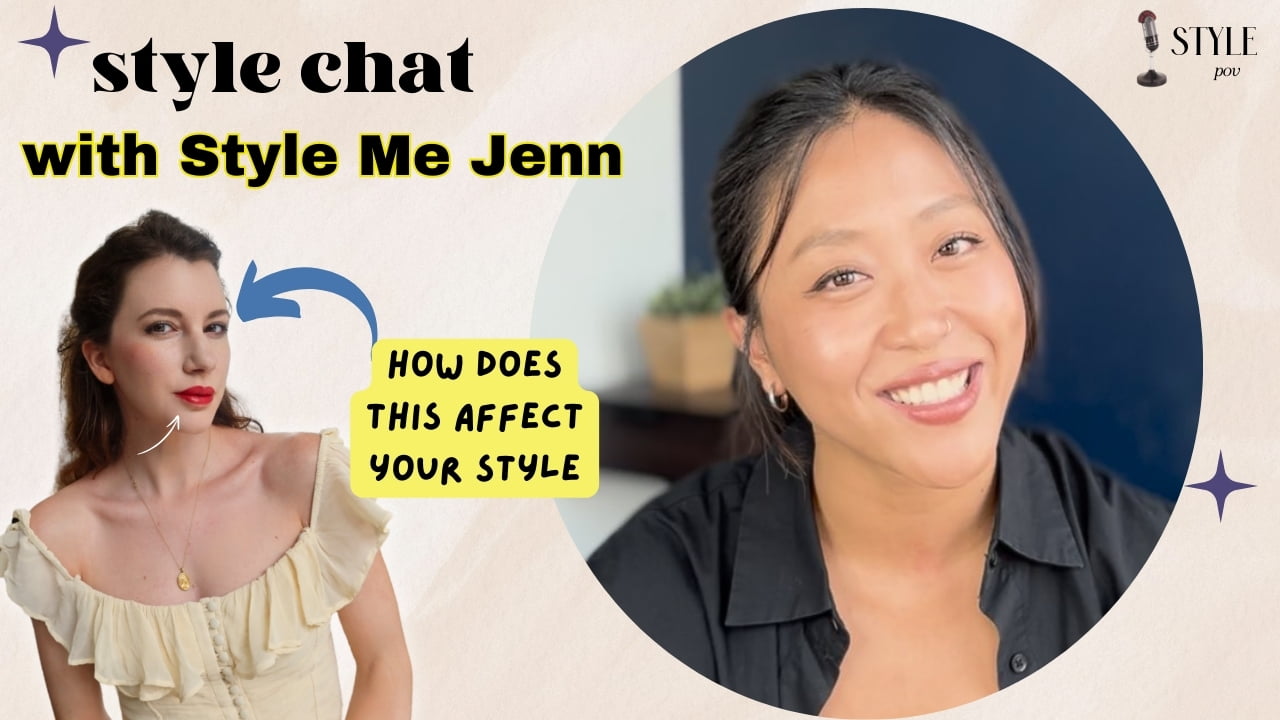
In this episode of the Style POV podcast, host Gabrielle Arruda engages with Jenn, a style and beauty analyst known for her YouTube channel, Style Me Jenn, to discuss facial proportions and how they impact personal style. The discussion covers how facial features like the shape and spacing of the eyes, nose, and lips influence styling choices, hairstyles, and makeup. Jen highlights the importance of embracing one’s unique features and finding an authentic personal style through confidence and informed decisions. Additionally, the episode touches on the broader subject of combining facial analysis with other style systems like Kitchener essences and seasonal color palettes to achieve a harmonious look.
Listen to it:
Prefer to see our faces, watch it instead:

More from Jenn:
- Website and Facial Analysis Services
- Instagram @styleme.jenn
- Tiktok @stylemejenn1
- Style Me Jenn Youtube
Mentioned Resources:
Skeletal Diagnosis Video (by Jenn)
Texture Podcast (by Gabrielle)
Auto-Generated Transcript
Gabrielle: [00:00:00] Hi, I’m Gabriella Arruda, the host of the Style POV podcast, and I’m here to help you hone your authentic style POV. learn to trust your fashion instincts and find strength through style. And today I am so excited to welcome Jen, a style and beauty analyst and enthusiast who you very likely know from her wonderful YouTube channel, Style Me Jenn
Gabrielle: now today we’re going to be discussing facial proportions and essences and how your face impacts your personal style. And if you’re interested, Jen also has a facial analysis services on her website, which are linked in the show notes. Thank you so much for coming on, Jenn anything you’d like to add?
Jenn: No, I just want to say thank you so much for having me.
Jenn: I was so excited to hear from you. And so excited to hear that, your listeners are interested. In having me as a guest so yeah, thank you so much
Gabrielle: a very requested guest So i’m sure everyone would be very excited to hear from you. , so before we go into specifically like facial proportions and facial spacing and how that impacts Beauty and style choices.[00:01:00]
Gabrielle: Let’s go a little bit broader I always like to get people’s read on what is an authentic personal style to you
Jenn: for sure. And I think this is something that i’ve really thought about for a long time and the definition for me continues to change over time. Right now where I am with this sort of defining what your authentic, what having an authentic style means is, like personal style is all about Decisions, right?
Jenn: What you’re gonna wear, how you’re gonna show up to the world today, and what to buy, what to not buy, what kind of trends to follow and not follow, and so it’s all about choices, and I think having an authentic personal style, is really important.
Jenn: means having the ability to say either like hell yes or hell no to items or outfits or trends and having that confidence and assurance about like why you’re making these decisions like why are you saying yes why are you saying no and i think that where that confidence comes from can really vary [00:02:00] by the person, like for some of us, it could be the wearing the right colors, wearing the right, outfits that match our essences, body types, whatever, but for other people, it could also come from just knowing why these things are wrong aesthetically, but still make sense to you.
Gabrielle: Yeah, I think your personal style evolves, so , it’s not that you were inauthentic before, you just have like new knowledge that you’ve now applied in new ways, and that’s why I think it’s so interesting to examine your face, because so often, where we start with our style is our body, why does fabric look like this when I wear it, or why is this not flattering on my body, or why isn’t this working for my body shape.
Gabrielle: And we forget that true authentic personal style taps into What makes us unique the whys behind why something excites us or why something is like just not our vibe And I find that so fascinating because I think that our face can unlock so many clues to the whys behind things and why we’re naturally drawn to something or why You [00:03:00] know for the past 20 years This has been a staple makeup piece or a staple earring or a haircut that you’ve just loved So Can you give a broad overview of the concept of like facial proportions and facial features and how it impacts personal style just so Everyone knows what you specialize in.
Jenn: Yeah. Yeah for sure So facial proportions is just looking at the proportions of the body you can look at someone and say they have long legs or long torso like the top or bottom heavy Like hourglass shape, pear shape, whatever And it’s taking that same idea, but applying it to the details of the face at a more granular level.
Jenn: And everyone looks different, right? No two faces are going to look exactly the same. So it’s about understanding the uniqueness of our own proportions and features and how they interact with each other. And the human eye naturally seeks balance and harmony. So if you have more prominent areas, [00:04:00] within the face that will naturally draw more attention.
Jenn: So like understanding facial proportions I think has , two main purposes. The first being deciding on the right hairstyle and makeup styles for your proportions and features. So choosing styles that kind of prevent one area from being excessively highlighted, or I should say unnecessarily highlighted.
Jenn: Like if you’re wearing a bold red lip, for example, and but you have some features and proportions that already draw a lot of attention to your lower face. So if you wear a red lip to make that area pop even more than it takes away from. People noticing your eyes first, for example.
Gabrielle: I think you gave that example in one of your videos of Julia Roberts doing that. Cause she has such a, like a strong nose and such a big smile that she just doesn’t opt for that often. Cause it would be almost too visually [00:05:00] heavy on the bottom of her face then, is that correct?
Jenn: Exactly she’s a really good example, and it’s not like her wearing a nude lip is gonna take that away from her her nose still has that character, she has that beautiful open smile, like, all of that is still there, it’s just we’re able to see, like, how beautiful her eyes are when her the lower face is not Yeah,
Gabrielle: it’s basically like trying to figure out what is the emphasis point and what are we naturally drawn to?
Gabrielle: And do we want to draw more attention there or do we want to balance it out? What are our options and what impression are they conveying? And does that impression match, one, what we want? And two, what the day needs? A bold red lip may not be the best option for your business corporate meeting.
Gabrielle: Because it’s too much emphasis on your lips, like understanding what your face is conveying. I think that’s super powerful.
Jenn: Yeah, absolutely.
Gabrielle: So how does one go about evaluating their facial features and [00:06:00] proportions?
Jenn: I think that there’s a lot of measures.
Jenn: You can look at the angularity of your facial structure to determine your face shape. Look at your horizontal proportions, your vertical proportions. And then we look at the individual features and the overall visual weight of the features. So all of those pieces of information come together to essentially show which area draws the most attention naturally.
Jenn: And what kind of impression these characteristics create.
Gabrielle: So you say that similar to how body typing systems are split you have the fruit body system types which are let’s balance this out like you’re pear shaped let’s put some stuff on your shoulder so you look a little bit more hourglass versus a system like kibbe or kitchener which is a little bit more about honing into your like authentic in and young balance and not really hiding your features but just letting your natural features shine.
Gabrielle: Would you say that also applies [00:07:00] to facial proportions and facial balance, that you can either hide or emphasize or rebalance your face with some of these techniques?
Jenn: Yes. I think in the previous question, I, talked about there’s two purposes, two facial proportions, and then we just ended at two.
Jenn: Like talking about one. So like the second purpose of facial proportions is understanding your overall style in terms of How do these features and proportions work together to create a certain impression? That my face gives off to other people and how does that affect your style choices in?
Jenn: Deciding on your preferences and what you’re naturally drawn to and what you think naturally looks good on You So I think there’s two parts to understanding facial proportions is one is all about like finding balance and like understanding which area to emphasize the most or de emphasize more versus so what is the overall impression that like all of these proportions and features create for [00:08:00] your face and like how are you going to connect that to your style that makes sense to you?
Gabrielle: Yeah so just to be clear what we’re talking about is we’re talking about overall face shape Like, verticalness of the face, width of the face, scale of the features, and how they’re spaced, essentially.
Jenn: Yeah, and then also the angles of your eyes, we can go into the details of angles of your eyes, how prominent is your nasal width, nose bridge, like how wide or narrow are your lips, how full are they we can go into like, all of those details.
Gabrielle: Do you think that some of this is related to an individual Kitchener essence or Kibbe body type? Do you think there are connections there or do you think that they tend to stand alone?
Jenn: Absolutely, I think there are Connections between proportions and I wouldn’t necessarily say Kibbe body types because maybe I just don’t understand Kibbe that all that well To begin with so let’s just start off with that and I know that like Kibbe is more [00:09:00] about the body it is in like a holistic essence system But I think like the way a lot of people use it these days is like look at Kibbe for your body type Kitchener for like your specific essence blend, etc so I think Facial proportions in that sense connects a little bit closer to understanding Kitchener essences In terms of let’s say like how youthful or mature your face appears Maybe how masculine or feminine your face appears even though I don’t really like using those terms all that much So I think there are definitely connections.
Gabrielle: That’s awesome can you give us some examples of how someone might use this data and how they might take it in a certain style direction?
Jenn: Yeah, for sure. So I will use myself as an example because I just use myself a lot in my videos to explain concepts.
Speaker 3: It’s always a little weird too, because you’re like, wow, I didn’t expect so many responses to talk about me.[00:10:00]
Jenn: But I think with hair and makeup, for example, like if I use myself as an example, I have a long face. My Horizontal proportions are pretty well balanced but I have wide outer face. So I have a long face, but also a wide face, if that makes sense. My eyes have a little bit of a sharper look. I have a long philtrum, like a very sharp and pointy chin.
Jenn: , my shoulders are the widest point of my body. So looking at all of that, I can, In terms of hairstyle, I can say, okay if I go for full blunt bangs, that’s gonna cover my eyebrows, cover my upper third entirely, and that’s gonna bring way too much focus to the sharpness of my chin.
Jenn: So maybe, if I really wanted to try bangs, I could go for the thinner, wispier styles of bangs that kind of expose the forehead and eyebrows a little bit, so it’s a little less harsh on the overall proportions. And then in terms of hair length, I have a long face, so maybe shorter hairstyle [00:11:00] will suit me.
Jenn: But what about then my shoulders? Because if I expose my shoulders, they’re going to appear wider. What about, do I want to do anything about my philtrum? If I’m going to wear long hair. a long hairstyle, then instead of having long blonde hair, do I want to add some layers so I can add that visual break and make the face appear less long?
Jenn: Do I maybe want to have a balayage or ombre style of blonde ends to de emphasize my chin from appearing too sharp? So we can go into all of these sort of details into know what are the areas that I really want to focus on or de emphasize and how am I going to use my hair and my makeup to do that?
Gabrielle: Yeah, that’s so interesting cause I feel like it’s so eyeopening when you start to look at the world through the eyes of balance. And when I say balance, it’s not even like being classic essence or perfect proportions, [00:12:00] but having elements to your face and your accessories in your hair that are All feeling like they fit and harmonize with one another that the eye Looks and can settle on the face and can see you, you know when we create kind of intentional contrast When someone wears like super sharp bold earrings that are super avant garde Our eyes immediately draw into the earring not the face like it’s our eyes can’t quite settle on the face It’s like whoa, what are those cool earrings?
Gabrielle: That’s where the eye is drawn to so this is like a wonderful way to find that like artistry that like Perfect composition the perfect painting Or the eye just naturally gravitates towards it. And you think wow, how did she know to do all those things? She just looks so polished, or she just looks so put together, because everything just feels so in line.
Gabrielle: Do you think that if someone has determined, let’s say something like their seasonal color palette, because that’s also, all about figuring out those best colors that support your natural coloring. And the, and then they figure out their facial proportions. For And [00:13:00] some of those things seem to counter one another.
Gabrielle: How do you think you can blend those together? I’ll give you an example. So someone has a very mature face. They have a longer midsection. They have bold visual weight to their eye shape and then they land on a light summer color season.
Jenn: I think someone like Kate Blanchett is a good example.
Jenn: You of having a mature impression. Maybe her eyes don’t have such a huge visual weight, but there’s definitely some sharpness and a bit of trauma in there. She also has this sort of weighted and grounded impression that’s created by a more prominent width in her nose bridge. She has a bit of an angular jawline that also adds to that effect, but like she overall she looks very soft because of I think she’s a light summer or at least like high value is her dominant trait.
Jenn: So I think she finds really cool ways to mix and match those mature impression with her coloring. [00:14:00] She wears a lot of like pants suits and lighter and soft colors, for example. And I think she looks phenomenal on that. Like I personally don’t like her when she’s dressed too feminine in terms of silhouette, like when it’s just a flowy dress, like in her colors.
Jenn: I think she loses that like edgy and cool and sharp impression about her when he lean, when she leans too far into dressing for the softness. So I think there’s definitely a balance between taking the information from how your face is and merging that with your color season.
Gabrielle: There seems to be a lot of customization needed in it. And that’s true with everything in personal style. Like we learn these systems, we learn this information and we think of it at first as just like the answer in a box. Like you open the box up, it’s going to give you the answer.
Gabrielle: Done. I can check off personal style on my life goal list and move on with my life, but really it’s about building on this. She’s a great [00:15:00] example because if you look at her whole career, she’s definitely come into her own style wise, I would say like later in her life. And she just rocks it on the red carpet nowadays.
Gabrielle: Like she knows her style line. She knows her color palette and she’s able to appear like you said, grounded, but somehow also ethereal and also where. this softness, which is beautiful on her. Now she’s, it’s funny because we can have so much admiration for someone like Kate Blanchett and how she appears on the red carpet, how she has this like mature poise about her, this regalness almost, but then when it comes to our own styles, I feel like sometimes the grass is always greener, you’re like I always look young and all I wanted to do is look like a sexy femme fatale Or, like the opposite of I look too mature, like I want to look fresh and sensual, or fresh and delicate, or youthful.
Gabrielle: How does one tackle that? And does, do facial features help you see that, and appreciate it?
Jenn: I think it definitely does. Like you said, I think the grasses help. It’s always going to [00:16:00] be greener on the other side. That’s just like human nature. And we just want to experience what we haven’t experienced before
Jenn: I also think it’s a bit cultural, like for example, I’m Asian and I have a lot of Korean friends. So like for me, growing up, I’ve always been told that looking older than my age is. Like it’s worse than looking youthful. There’s a whole obsession with looking youthful in Asian cultures in general and I can’t speak for other Asian cultures, but at least in Korean culture.
Jenn: So there’s this like weird obsession. I’ve always felt like I don’t have what it takes to be desirable, and that kind of fosters the envy. More in my opinion like it makes the grass seem even greener on the other side but I can’t really have it all right like it’s what I have Somebody else may lack in and what I lack in The other person [00:17:00] might have like it’s always a bit of a trade off and I think at one point we just have to come to the realization that Unless you have plans to overhaul your entire face, which like you can’t really change some proportional factors with plastic surgery anyways.
Jenn: But just at one point, I think you have to accept who you are, both internally and externally. And there’s, you just have to realize that there’s beauty in every type of face. Beauty is not a narrow minded concept.
Gabrielle: Yeah, that’s so interesting I really it is hard though because you know We go through so much of our lives like trying on new personas and trying on new trends And sometimes it’s so obvious oh this trend does not work for me and other times you’re like I can make it work if I do this I think that’s a it is an interesting point too that it ties to color analysis because some people Here’s this movie with Debra Messing and she’s likely thought of as a true [00:18:00] autumn, right?
Gabrielle: That’s true autumn, maybe dark autumn. That’s where people place her. and she’s wearing black and she’s wearing makeup and it doesn’t look terrible on her like it looks fine and then there’s a scene where she gets wet in the dress and all of her makeup is gone and all of a sudden you’re like whoa all without the makeup with the wet dog look like all of a sudden that black is draining your face so we also have to understand the spectrum of things I think because sometimes we can make it work if we have one or two features that align with it And we just have to tweak our understanding of a trend or a color or a style direction or a haircut, let’s say, and make it work for us.
Gabrielle: And other times we have to look at it objectively and be like, no, I’m going against too many of the things in my face, , I have too many elements, like just fighting it out to the death, that none of this is working. Do you think it’s possible to lean into a trend, even if it doesn’t naturally fit, let’s say, your proportions or lean into a makeup [00:19:00] style if you’re willing to tweak the other parts of your face?
Jenn: I think there are definitely ways to incorporate your own preferences that may go against Your features or the natural impression but I think it’s just dependent on , how do you want to do that? Like for me
Jenn: let’s say I have a mature face I think I have a good balance of like feminine and masculine features So maybe I can play a little bit more on Like leaning more masculine versus leaning more feminine but if knowing that I have a very mature face if I wanted to like all of a sudden go like All the way lean really into the ingenue styles Like that whole aesthetic like that’s obviously going to look really off on me.
Jenn: So I think it’s just about like Understanding where on the spectrum you sit and how you can tweak things to make things work for you Instead of just like I want this style and i’m [00:20:00] gonna try it And then realizing that’s just that’s not how it works.
Gabrielle: Yeah,
Jenn: or it just looks off, right?
Gabrielle: Yeah, I think it’s about finding your boundaries, like seasonal color analysis is finding your boundaries within the color wheel like Where’s my darkest?
Gabrielle: Where’s my lightest? Where’s my most muted? Like finding where the edges are and then working in that sweet spot And I think it’s like that with all these elements too because you have a lot of different pieces Is all combining between hair, makeup, emphasis points, balance, mixing with your style.
Gabrielle: And if you go too far in one direction, it can scare you away from it. So in a previous episode on this podcast, I had Andrea Flaumeur, and she’s part of the Kitchener PCS Essences, and she had my blend as Ingenue Romantic and Gamine. And I was like, First a little shock, but then when she was talking about gamine, I was like, I have tried to make gamine work for I’ve wanted gamine for so much of my life.
Gabrielle: Like I’ve loved it and I’ve tried so hard to make it [00:21:00] work, but I think I loved it so much that I just turned the dial up to a hundred percent every time I tried it. So of course it’s not a hundred percent in my blend. So like when I turn that dial all the way up, it’s just not, it’s good, do you think that sometimes people have trouble? They get stuck on their face, or they can’t quite see visually where they fall. If so, what do you do with that?
Jenn: Yeah, I think, honestly, self assessment is the most difficult. This is my job to analyze people’s faces, yet, like, when I look at mine, I’m still always wondering, is there something that I’m missing?
Jenn: So I think looking at ourselves in an objective manner is really important. is always difficult. You’re not alone. If anyone listening is feeling that way, like you’re definitely not alone. And maybe think about what others have told you in the past, right?
Jenn: Like the outfits you receive the most compliments about, or what people say Oh, you look so sexy in this, or you look so cool. Think [00:22:00] about what kind of outfits. Or what kind of hairstyles or makeup styles you’ve received the most compliments about. Because that can give you an idea of, oh, these are the styles that really suit me well, like judged by other people in a more of an objective manner.
Jenn: And then also look in your closet and see what are your favorite items? Like in my opinion, our preferences can somewhat be shaped by These compliments and knowing what looks good on us because, we all want to look good at the end of the day, and I think we have, whether we know it or not, we have an inherent understanding of what looks good on us, like whether it’s through, it’s because you’re just a visually gifted person and you know these things, or through,
Jenn: trials and errors like in your case of trying the really extreme gamine styles. Like we have an inherent understanding of what looks good on us [00:23:00] already regardless of whether we’re aware of it. So maybe try looking into what your own preferences are and what your favorite outfits or items in your closet are.
Jenn: And I think that can give you more clues than you realize.
Gabrielle: I think sometimes we also have to step back because we like Find out a new system or we find out a new Way of measuring something and we get so excited about it and we consume all the content You know around it and then we’re sitting on the subway and we’re like analyzing people’s, facial and like wow Long mid third or it’s Obsessing over it and then it gets hard to zoom out and look at your face as the whole You can’t really see how things are working together You And from what I understand, it is a holistic view of your face at the end of the day.
Gabrielle: You can parse out whether you have a long mid or high cheekbones or sharp angular lines, but , if you have one sharp feature, that’s not going [00:24:00] to dictate everything else in your face.
Gabrielle: So can you talk a little bit about some of the misconceptions or mistakes people make when they start exploring facial proportions and facial balance?
Jenn: I think what you just mentioned is one of them about getting fixated on one area and I also think that’s why it makes self assessment so difficult because we look at our face every day and we can like really nitpick the details if we wanted to, right?
Jenn: Like totally go down that rabbit hole. So I feel like it is difficult to step back.
Gabrielle: I also think like it’s so valuable to have someone like you give someone a facial analysis because You can be objective about it and you can look at it with fresh eyes Because we’ve lived with our faces for however many years we’ve been alive and we have preconceived notions about our face and we have like decades of You know Being told we’re one thing when we’re actually another or you know Someone made a comment about your nose when you were [00:25:00] younger and you’re so fixated on the shape of your nose, you know We have hang ups when it comes to our face so there’s a lot of benefit to getting that kind of like outside person to be like no your face is actually very balanced or you have a beautiful focal point in your lips and Here’s what to do with that.
Gabrielle: So I encourage everyone to reach out to Jen if you’re interested in this because I think that’s super, super helpful in being able to get an outside opinion. So when you give your analyses, do you find that people are Receptive to the information, or is it sometimes difficult for them to accept this new information and put it into practice?
Jenn: I definitely think it takes some time to accept it and Explore, you know your with your style With the newly gained knowledge.
Jenn: I think like you said there’s these sort of notions we have about ourself versus what others are saying about you objectively. [00:26:00] Maybe if there’s a huge disconnect, it definitely takes more time to accept all of the information. But I think you just need to look at it as this is just the beginning, right?
Jenn: Another common misconception is that like people assume that my services is. The answer it’s like the end, you know It’s about getting answers to like solving my difficulties about my style and appearance, But I think it’s the opposite It’s just the beginning if all this information you’re now getting on your proportions and like your best features You know your impression whatnot It’s for you to start Your exploration phase with your hair and your makeup and your overall style now that you have more knowledge And there’s the initial guide of which way you might want to explore But like the exact answer of this is your best style that can only come from you [00:27:00]
Gabrielle: I love that.
Gabrielle: Yeah, I think that’s so true. I think that we get hyper fixated on names or categories and boxes Is And then we have this like complicated relationship with both of them too because we want the answer, like we want to know our color analysis or our face shape or any of these things. But then, the answer becomes more important, like the name, than the actual application.
Gabrielle: And it really is about taking this objective analysis that you give someone And then seeing how it shows up in your own personal style. Maybe it unlocks something that you’re like, Oh my gosh, I had a pixie cut when I was, 14 and I got so many compliments on it. And now that makes sense. Like you understand the reasoning and that can extend to so many other decisions you make because you understand those whys instead of feeling boxed in.
Gabrielle: Oh I can never do this haircut because I have this, it’s actually very freeing. And I think that’s so empowering to [00:28:00] view it as the start, as the beginning to something, and to have the confidence that the information you’re, you have is correct, so you’re on the right path, but your subtle route, your direction, how fast you get there is all at your own pace, is all, about you.
Gabrielle: How do you think someone should work systematically with their personal style? What do you think should come first? So they have their facial analysis with you. They understand what’s going on there. They’re starting to make decisions. What would you say should come next or how should they explore that?
Jenn: First experiment with like your hair and makeup first Maybe if you don’t want to get a haircut because that’s more permanent like try styling it in a way That’s based on your proportions and features based on the information that you receive from me. Try experimenting and really get to learn your face more in an objective way.
Jenn: And then, like I said look through your own closet and start analyzing that as well. What are your favorite [00:29:00] items or outfits? What kind of impression do they create? For you and like how does that relate to your proportions and the overall impression of your face? And I think things like colors body types silhouettes aesthetics like all of those things I think can come Afterwards once you have a general direction of okay So this is an overall image that I look good in or this is an overall image that maybe doesn’t even work That well for me, but I still want to try pursuing it Anyways, like I think once you have that Overall direction then you can start diving deeper into colors or like what are your best silhouettes?
Jenn: What are your best colors? Maybe patterns Textures, etc
Gabrielle: Yeah, I totally see that I think there’s like a lot of benefit to working top down if you will from your head first because You can have an outfit that’s off. But if you have an amazing hairstyle, that’s just signature perfect for your face Or makeup [00:30:00] that just suits you so And that can be your fallback.
Gabrielle: You’ll have some pretty good style days. You’ll feel pretty good about yourself, you won’t be, like, waking up and being like, Ugh, like, why does this just not work for me? Because you at least know, okay I’m looking up, my hair is good, my makeup’s looking good, like, all these things are in line, and now I gotta work on the clothes, but at least I feel like when I look in the mirror, I’m seeing me, I love that approach. Now, I know you talk a lot about color analysis as well, but I feel like these two things go hand in hand cause when you work on your makeup, and you work on your hair, like you dye your hair, I feel like it can really throw off your perception if you choose a color that is outside of your palette, or super against something.
Gabrielle: And it can lead you to like the wrong, conclusions, you think, Oh, I can’t wear a red lip cause you’re wearing the wrong red lip, or I can’t wear heavy eye makeup because I’m choosing, super stark, vivid white and black. And I’m a soft summer, I think [00:31:00] those two things can go so well together.
Gabrielle: What are your thoughts on that?
Jenn: I think that it could be related in terms of contrast level. Like you said, maybe a bold red lip might not work for me as a soft summer, but it might also be about like how you’re applying that bold lip. Are you like using really defined lines like a typical sort of like bright winter style of red lip, or maybe you’re mixing a couple of different colors Smudging the outline using a softer color along the outline so it doesn’t appear as harsh.
Jenn: So I think in that sense you can make the connection to like the overall contrast level. And that has some relation to both facial analysis and facial proportions because it relates to your visual weight. The bolder, more contrasted your features, the higher the visual weight is going to be.
Jenn: So I think contrast is definitely, the link between visual [00:32:00] analysis and colors. It’s not just about what kind of colors you’re choosing, but like how are you using those colors. That plays a huge role in whether a look is going to look good. More cohesive or not.
Gabrielle: Yeah, definitely. I mean with each seasonal palette They also do recommend like certain techniques too, as you said soft summer is much more blotted much more softer You’re not doing sharp eyeliners and or you’re toning them down In you know a charcoal muted gray instead of a sharp black cat eye So there’s always some give and take but I think then they seem to be so intertwined to get like that perfect Kind of harmony that we’re seeking Which leads me to there’s all these names within Seasonal Color, within Kitchener, and they can lead us to have biases, obviously.
Gabrielle: Like some people want to be a certain essence, some people don’t want to be a certain essence. Do you think that these type of systems and their names can lead us to Misinterpret our facial features or [00:33:00] want to be a style that maybe doesn’t suit our facial features because they have these like kind of names attached to them.
Jenn: Yeah, definitely. A hundred percent. I think masculine and feminine are the two words we had already talked about.
Gabrielle: Yeah.
Jenn: Or like even mature and youthful. Like when you say somebody looks mature, like that could be taken positively, but somebody might take offense. Yeah. Hearing that they look more mature, right?
Jenn: So I think it definitely does create some biases. But I feel like it’s often like the faces that have a mix of all of these features that like we are so mesmerized by and drawn to like Kate Blanchett is a great example. I can’t even describe her but everyone can agree that like she has this.
Jenn: mesmerizing look to her, right? There’s definitely bias and it’s important to Understand that being one way is not better than the other Like nothing is black and white like that No, [00:34:00] and maybe with facial analysis because things are so technical like we’re measuring proportions and facial features that people think that it might provide an absolute answer and to some degree it does because if you have a long face, you have a long face like it’s not gonna be short like that is a fact, but it doesn’t make long faces better or worse than short faces.
Jenn: So I think in the end it’s about understanding it is a gray area that we’re exploring because. Our faces are complex and we are complex so there isn’t a right or wrong answer.
Gabrielle: Yeah, I think there’s a lot of value in also seeing the spectrum of each essence or of each, qualities like long faces and it can be really easy to see the beauty in others and hard to apply it on yourself.
Gabrielle: But then when you see someone with similar features to you or a similar essence blend, you can see the beauty in them. You can learn to turn that back on yourself. Like you can [00:35:00] admire Kate Blanchett for her strong bone structure and her poise and regalness and her, lighter coloring.
Gabrielle: And if you have that, you don’t have to assign that to, Oh, she has a masculine face. That’s not what we’re about. That’s not accurate at all, even if she has strong bone structure. So hopefully I think that if you can move past the stereotyping. that seeing the spectrum of each of these things or seeing the spectrum of how it works when someone like Anya Taylor Joy wears the same makeup as someone like Cate Blanchett, they have very different bone structure, you can see the impact and you can relate to it instead of, having those biases creep up where you reject something outright.
Gabrielle: Do you think that facial analysis is a way to explore the why behind your style instead of those names?
Jenn: Yeah, that’s the reason why I like facial proportions so much is because like I said, it doesn’t provide absolute answers, but [00:36:00] it does provide you at least like some clarity, because these are measurements we’re looking at, like we’re looking at the width to length ratio of your face.
Jenn: We’re looking at how like high your forehead is compared to your mid section and your lower third. It does provide some factual knowledge that why factor behind this is why you look youthful. This is why you look more mature, I think it helps you provide that sort of direction and explain why like you have an ingenuous sense, why you have a romantic essence, why like it does definitely help provide answers to those whys.
Gabrielle: Yeah and it’s like slowly uncovering little things about your face that you might not have noticed. or understanding the impact of certain choices you have. You do that cat eye and you’re like, it always looks funny on me. Am, is it just I can’t pull off a cat eye? Or am I placing the wing improperly?
Gabrielle: I know you have a [00:37:00] background in, you went to makeup school, cosmetology, and I think in one of your videos you talk about how when you were trying the makeup, like some of it just didn’t work on you and, Like the techniques were all right, but like the actual styles didn’t is that what kind of got you into this?
Gabrielle: because it’s like that I have a similar thing that I was in fashion design and you learn to Make garments and you learn to fit them on bodies and you learn to use fabrics properly for the design But we didn’t ever really talk about what to do To make it make that body shine, you know It was make it fit make the garment function on this body, but it wasn’t Do these harmonize together really?
Gabrielle: Is that kind of what drew you to facial analysis?
Jenn: It actually is. Yeah, so I went to makeup school back in 2016 2017 and Yeah, we just focus so much on Executing the technique correctly, which of course that’s a skill you need to learn in a [00:38:00] professional school like that, but a face is not A blanked canvas it is but there’s different nuances to a face that Blank canvas does not provide and you can’t just paint In the same way that you would onto a piece of paper or onto a canvas, right?
Jenn: So I yeah, that’s when I realized. Oh my god. I’m like seriously looking botched every single day and It’s not necessarily that these techniques are bad. Or Like the techniques are not being followed to the T. It’s just that it’s not being applied more fluidly to the features and the proportions of the specific faces.
Gabrielle: Yeah.
Jenn: So it was definitely like a huge eye opener for me to learn about facial analysis and realize, okay, it’s not just because I’m less attractive that I can’t pull off these like dramatic styles of eye makeup. Just, I just don’t have the features for it, and that’s totally [00:39:00] okay, because, I have my other strengths.
Gabrielle: Yeah, that’s about seeing the beauty in your own features, and how to highlight them and not feeling you’re not pretty enough to try something. I love that, because I think this whole journey is a lot about unpeeling an onion, and trying to find, your core priorities, and your core essence, and bringing out those inner traits.
Gabrielle: And I love when things can merge like scientific reasoning with the art because then you can take those facts and apply it in your own creative way or tweak it so that it creates the effect you want. This has been so wonderful and if you will indulge me I have some reader questions or listener questions that were sent in ahead of time because everyone was very excited that you were coming on if you’re okay with that.
Gabrielle: Yeah for sure. Okay so the first one is What do you do if you have different types of impressions between your features? For instance, bold, large eyes and thin, narrow lips.
Jenn: I think it’s all about the overall [00:40:00] vibe at the end of the day. Once we understand all of these proportions and features the uniqueness of it and all of that, once we finish getting fixated on every single one of these topics, then we have to step back to, , think about okay, so what is the overall vibe of my face like if we’re really looking at things objectively What is like that one or two words that other people would describe your face?
Jenn: Instead of I have really like large bold eyes that are super round And that create this like doe eye Effect and I have really thin lips instead of saying getting fixated on those individual features You have to step back and think about, okay, so what do the combination of all of these features create for me, for my impression what is that one unique identifier that people would say about me is, I think you have to get an understanding of that.
Gabrielle: Looking at the features as a whole and how they’re playing off [00:41:00] of each other. So if someone has bold large eyes and that might be a focal point And they’ll have to decide the balance whether they add a balance point or whether they emphasize the eyes Etc, right?
Jenn: Yeah, exactly.
Jenn: And like in most cases we are all like that like we Have a mix of everything like there is actually much rarer to come across somebody that has One type of everything, like It is usually a contrast and a juxtaposition created through different features that I see in my client’s faces.
Jenn: But it’s just the overall effect of so what does this all mean for you? And what kind of impression does this create?
Gabrielle: Yeah. So the next question is, how did you personally use this information to find your style and best makeup pair?
Jenn: I think this is a still work in progress. I don’t think it’ll ever like fully be Completely realized because like you said we’re changing as people [00:42:00] and maybe something that I think works for me right now Won’t work for me In five ten years down the road.
Jenn: So I think it is a work in progress But I try to see it Now, I am sharing a lot of content about these are the reasons why my hair is this way. I’m using layers for my hair. These are the makeup techniques I use to visually shorten my felt trauma, etc. But, I’m just starting to realize more and more that this is just a way of having fun for me.
Jenn: Trying out different styles and learning more about myself and my style.
Gabrielle: Yeah, I think that’s so important. If a system or something that you’re learning about isn’t sparking joy or encouraging excitement or creativity, then it might be time to put it aside. None of these things should be, like, arduous and terrible and something you hate doing on a daily basis.
Gabrielle: They should just be, like, fun explorations where you try things and you start to land on, this felt really good. Let me pull the thread to see. What [00:43:00] else can I do with this? Can I push it a little farther? Can I take it in this direction? It’s all little clues to Finding something that feels Really good when you put it on or really happy when you look in the mirror.
Gabrielle: Yeah. Yeah, totally So are there any techniques to quote override? Unquote a facial feature if we are drawn to an opposing look
Jenn: I think it’s just confidence at the end of the day like Like I said, authentic personal style, I think, comes from confidence in knowing why I’m choosing this outfit or this aesthetic or why I’m not choosing to follow certain trends and etc.
Jenn: And if you are so drawn to a specific style that you know is completely opposite of your features but you’re still drawn to it, like, why not? Go for it. You just gotta have the confidence to say yes.
Gabrielle: Yeah, I think that’s an important point though too is like confidence and going [00:44:00] for it because I feel like sometimes when we’re a little Hesitant it’s like we’re not willing to take the full look there You know if you have really small lips really thin lips But you do Want to do a red lip and you found your version of red like go all the way like don’t be afraid to create that whole head to toe look that matches that red lips because that’s really gonna take it to the full picture.
Gabrielle: And as we mentioned, like our eyes want to create those balance, those connection points. Our eyes want to be able to go from your head to your body, to your clothes and be like, wow, all that stuff really makes sense. So just like committing to it and having that confidence, I think you can get there.
Jenn: Yeah, definitely. And I think because my content is based on looking at facts and, it’s red lip lips look weird on you because of these factors that doesn’t mean go don’t go out and wear a red lip if you’re really drawn to it like go for it but it just helps you explain that why and hopefully [00:45:00] understanding that why will give you that confidence to say like fuck it i’m still gonna go for it anyway
Gabrielle: definitely yeah so what if we fall in the middle of the spectrum or our facial features feel in between They ask specifically about your doe eye version of a siren eye, having the almond eye shape, but the lid goes down at a certain angle.
Jenn: I think this is like where your preference can come into play which direction do you want your style to go to? Do you want to offset the the downturned angle of your eyes to really accentuate the sharp shape of your almond eyes? Or do you want to neutralize that sharpness more by enhancing the angle of your eyes more and therefore creating a more relaxed and sort of soft vibe and enhancing that
Jenn: so I think this is where your preference can really come in and It’ll have to depend also on the look you’re going for the day.
Gabrielle: Yeah, that makes sense. The next question is all about haircuts because we all know having a good haircut is like [00:46:00] magic, right? So is there an element that should be prioritized since you have like face shape, features, proportions?
Gabrielle: Is there one that like is the best to start with if you only know one?
Jenn: I think that again like Your preferences is a huge factor But let’s say if I have to pick one feature to really focus on and prioritize on I would always say it’s the eyes, like it’s the windows to your souls and you want people to look at you in the eye and notice your eyes first, right?
Jenn: And that’s like the goal of facial analysis and finding your proportions A lot of the times it’s let’s Get your eyes to pop or be the most accentuated feature within the face so if you really are like trying to decide which area of the face needs to be emphasized more through hairstyle, then I would say focus on your eyes and Try to think about what [00:47:00] kind of an impression your eyes create as well
Gabrielle: Yeah I think it ties back to your banging example in the beginning like if you did Sharp bangs across your forehead how that would Drag your face down or make your bottom half of your face feel heavier.
Gabrielle: Whereas like a curtain bang would keep the focus up here. I think that’s also one of those things, like we have so many advancements with I hate to say it, but like AI face or hair stuff, that it would be a bad idea to try on a haircut and do a squint test and be like, what am I noticing here first?
Gabrielle: Is it just all hair and big bangs, or do I notice actual facial features when I do this? Because you’re right. I think the eyes are super important. Someone wanted a little bit more information on skeletal diagnosis systems.
Jenn: Yeah, so I made one video about that and like my knowledge about the system is also pretty, pretty basic.
Jenn: It’s just something that I’ve noticed. It is a Japanese system and it’s something I’ve noticed that While I was doing my research around like Kibbe and body [00:48:00] types, I came across this. It’s a simpler system because it only types you into one of three categories. And there’s also definite parallels to Kibbe to some extent as well, because we’re looking at bone structure and how the flesh falls onto your bones and hangs on your bones, it also focuses on where the weight is focused. So , is the majority of your weight in your upper body, is it in your lower body, or are you centered and balanced? So I think that’s also another factor that determines which type you would fall into. Apart from that, I have the details in my video So like I don’t want to go into like too much details as to what each type means just for the interest of time but there are some Parallels to kippy.
Jenn: And what type of fabrics and patterns and styles and Are you the most suitable [00:49:00] one?
Gabrielle: Yeah, and we can make sure that video is linked in the show notes if people are not familiar with it for sure. One quick note, so I have a Another episode a solo episode where I talk about The textures of the face and like how they naturally apply to textures and in fabrics. So someone like Elle Fanning, let’s say, she has very lightweight textures to her face, and that’s why lightweight, soft fabrics.
Gabrielle: Now that’s linked partially to color analysis, but it’s also linked to the texture of her skin, having this translucent quality and the light fineness of her hair, looking at it like, if we were to draw this person, what medium would we be using? Would we be using like sharp, the big markers to create like strong, bold Things would there be heavy lines?
Gabrielle: I think this kind of like would be interesting to tie that into your facial proportions as well And how the two merge because in my mind as you were talking about this I was thinking yeah, like some features feel like they’re drawn more boldly or [00:50:00] some features are pulling that weight. So I Maybe you will come on or we can talk about it at a future date But I just wanted to throw that out there because I think these two things are really Connected.
Gabrielle: Anything you would like to add or I’m gonna make sure that everyone knows where to find your wonderful services so that they can get that Very important third party perspective on the features of their face and their how it can impact their style. But please share any last thoughts or anything you’d like to close out with.
Jenn: Yeah, I just want to say thank you so much for having me today. I, that was really fun and I do also want to say I am in the process of rebranding my channel right now We might change the name go with a different color theme aesthetics and whatnot Not that will impact my services all that much but in terms of the content I create based on the questions, I feel like and maybe this is because it’s related to the way I Present my content [00:51:00] right now is You We tend to get really fixated on what do I do if I have really angular jawline?
Jenn: What do I do if I have like bold eyes and thin lips? And tend to focus on that like individual features and how to solve those problems in a way. And I think if that was part one of where my content has been so far with the rebranding and the restructuring of everything, I do want to focus more on talking about taking that step back and how all these proportional factors and the individuality of your features.
Jenn: Create and enhance a certain impression and how that relates to your overall style
Gabrielle: I will make sure that Any updates to your content are updated in the show notes so that people can always find you even if they listen to this in the future and I think that’s it’s important to remember that as anyone who creates content online You know, there’s an evolution you start somewhere.
Gabrielle: It [00:52:00] resonates with people you see how people are using the information you get feedback And then you realize like maybe there’s a better way like maybe the next step is about doing it this way. You’re building upon that information So I think that’s wonderful and I get so much value out of your videos I know a lot of my audience does as well and i’m excited to see where you take it because I think those whys and that holistic perspective Just really allows you to tap into that authenticity and find A lot of happiness in the full picture, you know
Gabrielle: thank you so much for coming on. Until next time.
Jenn: Thank you.