
Fashion Is Not Frivolous: Identity, Power & Psychology with Dr. Valerie Steele
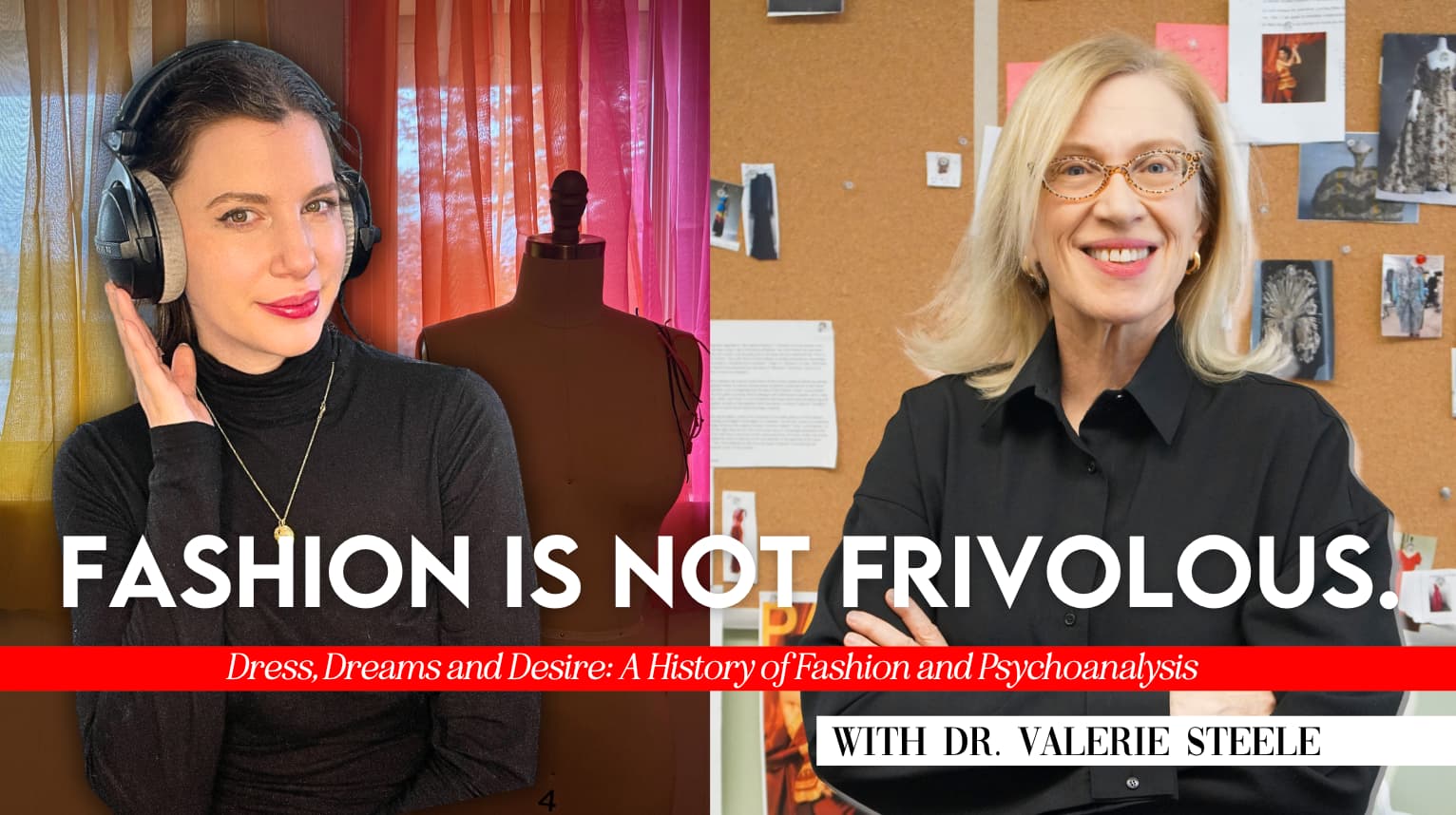
Photo Credit: Smiljana Peros
In this episode of Style POV, I’m joined by Dr. Valerie Steele, fashion historian, author, and director of The Museum at FIT. Dr. Steele has shaped the way the world understands fashion. Her work examines the cultural, psychological, and emotional forces behind what we wear and why it matters.
We talk about her latest exhibition, Dress, Dreams and Desire: Fashion and Psychoanalysis, and explore how clothing reflects fantasy, identity, memory, and the unconscious. If you’ve ever felt that what you wear holds meaning beyond the outfit, this conversation will affirm it.
In this episode, you’ll learn:
- How fashion became her lifelong pursuit and why it is never frivolous
- Whether corsets were oppressive or empowering
- The psychological connection between clothing, identity, and desire
- How style can be armor, transformation, and storytelling
- Why fashion is a “deep surface” with layers of meaning
If you enjoyed this conversation, make sure to follow the show and leave a rating. It helps more listeners discover Style POV.
We may earn a commission from you clicking a link below. And as an amazon associate, we earn on qualifying purchases. Full affiliate policy, here.
Listen to it:
Watch it:
Where to Find Dr. Valerie Steele

Website: The Museum at FIT
Instragram: @valerie_steele_fashion
Dress, Dreams, & Desire: A History of Fashion and Psychoanalysis, find it here.
FIT Exhibit: https: //www.fitnyc.edu/museum/exhibitions/dress-dreams-desire
Timestamps
01:01 – Discovering fashion as more than ‘frivolous’
03:31 – The corset: Liberating or restricting?
05:59 – Clothing as parts of history
09:48 – Pacing of fashion evolution
14:27 – Traditional psychoanalytic fashion ideas
17:07 – Gender fluidity in fashion
22:51 – Identification and fashion
30:33 – Clothes as armor
35:29 – Dreams, Desires, and Psychoanalysis Exhibit
42:03 – The idea of a deep surface
46:20 – Major fashion influence
47:38 – What’s next for Dr. Valerie Steele
Transcript
(auto-generated)
Gabrielle: [00:00:00] Welcome back to Style POV. Today I’m joined by someone whose work has fundamentally changed how we understand fashion. Dr. Valerie Steele, historian, author and director of The Museum at FIT, has spent her career revealing the cultural and psychological depths behind what we wear.
Her latest exhibition Dress, Dreams and Desire: Fashion and Psychoanalysis explores the hidden language of clothing, how our wardrobes express fantasy, memory, and the unconscious. It’s a breathtaking reminder that fashion is never fabric. This was such a valuable conversation. It was thoughtful, generous, and truly illuminating.
Dr. Steele is so amazing, and I cannot wait for you to hear all her fascinating thoughts. Let’s get into it.
Thank you so much Dr. Steele for coming on the Style POV. We are so honored to have you on the show. You spent your career proving that fashion is more than frivolous and like that it’s a lens that we can read history and human behavior through.
What first convinced you that you could do that? Like that it could hold that kind of cultural [00:01:00] power?
Fashion is power, not just ‘frivolous’
Dr. Valerie Steele: I think that I’ve always thought that fashion was important, even though an unacknowledged, aspect of history and culture. In my first term at graduate school, I’d gone to Yale to study modern European cultural and intellectual history.
One assignment was to report on two articles from a scholarly journal, and I don’t really remember what I reported on. I assume it was something about the French Revolution. But my classmate, Judy Coffin, reported on two articles from the scholarly journal Signs, the feminist journal debating the meaning of the Victorian corset. Was it oppressive, dangerous to women or was it sexually liberating? And it was like a light bulb went on.
I realized fashion’s part of culture, I can do fashion history. So I went to the library and discovered that there was a lot of great fashion journalism and some of what I will call kind of ‘costumes history’. It was certainly not social or cultural history. It was a bit antiquarian [00:02:00] and I thought, great. This is wide open now. I didn’t realize at the time how particularly in academia, it was seen as a frivolous subject.
I remember a very important intellectual historian asked me what I was working on and I said fashion. Then he said, that’s really interesting, German or Italian? I thought, what’s he talking about, Lagerfeld? And then suddenly the penny dropped and I said, ‘no, no fashion like Paris, not, not fascism.’ He literally just said, ‘oh,’ and he got up and walked away. There was nothing to say, but I was convinced that it was important and these people were just oblivious to that. But eventually they would catch on.
From that point on, everything I did in graduate school was focused on studying fashion. If I took a class on social history of impressionism, I looked at paintings of the Parisian. If I took a class on 18th century England, I did something on the [00:03:00] Macaronis. These are fop, young man around town. So in that way it became really the focus of my work. My dissertation then was on the erotic aspects of Victorian fashion including the corset.
Gabrielle: Yes. Can you talk a little bit more about your corset? Because I know you have a lovely book all about fetishism and corset play and how it can also, like you referenced, be liberating or restricting. Do you want to talk a little bit about that and how fashion can encode our taboos and our values and maybe even like our aspirations in that sense?
Dr. Valerie Steele: Well, there are two books that were related to that.
Gabrielle: Okay.
Dr. Valerie Steele: After Fashion and Eroticism, my first book, I did Fetish: Fashion, Sex & Power which also had a chapter on the corset, but it brought it up to the present. I was interested in how certain things like high heel shoes or cross-dressing or corsets moved out of sexual subcultures about fetishism or cross dressing and into high fashion.
There were so many designers from Vivienne [00:04:00] Westwood to Gaultier, everybody was doing corset. So I wanted to investigate how our perception of the course that had changed. For centuries it was something that was both beautifying but also respectable. It gave you sexually dimorphic curves, but it also proved you were not a loose woman.
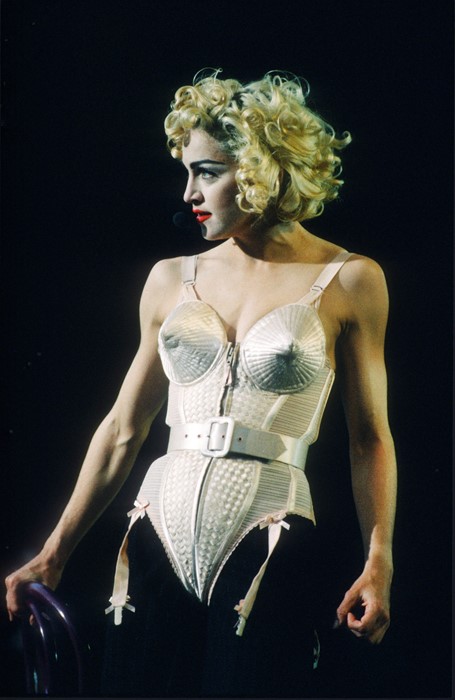
You were sort of, your body was contained and controlled. Then in the modern period it became much more. From the punks onward, a sign of sexual agency that the woman who wore of corset was stating that she was sexually independent, powerful. It became something that a lot of dominatrixes wore, and then of course, once Madonna did it, then it seemed to change its cultural aspect from being oppressive to being sexually aggressive.
Of course, there is no meaning inherent in an object like a corset or a high heel shoe. Entirely a meaning that’s constructed and reconstructed in [00:05:00] society. So there are changes in the meaning of clothes all the time. You can’t ever say that there’s a single meaning. A high heel shoe can be a phallic symbol, but it’s not necessarily that a woman who has a closet full of high heels is not really looking for a collection of phallic symbols per se.
Gabrielle: I love that you’re talking about how the contextual meaning is so important to these pieces. What do you think triggers these evolutions of something like the corset? Like how does it go from being this one meaning of like proper lady to something so sexual to a form of agency.
Are there cultural triggers that you think happened to that or is it a reaction? Is it us trying to take something and make it our own, like a decade being like, we want to take this piece and identify through it to communicate through it in a different way. Do you think there’s any cultural kind of triggers that help progress that language of clothes?
Dr. Valerie Steele: Well, I think you have to remember [00:06:00] that clothes are themselves parts of history. They’re not just reflecting history. Even in the 19th century, at any given time, there was a range of attitudes towards the corset. Some people thought it was necessary for respectability. Other people, particularly in the later 19th century, started to reject that.
I remember one woman talked about how she used to peel off her shell and her parents were upset when they discovered her, you know, soft bodied form. She wanted to not wear a bone corset anymore, and her mother was okay with that, but her grandmother was like, but what if a man touches your waist and discovers this sort of soft flesh?
So discussion is going on at all times. A lot of people who opposed the corset were men who thought that women should be baby making machines and the corset might interfere with that. Then a lot of the people who defended the corset and indeed who started to design corsets were women who basically said, if I want to wear something, I’m going to wear it.
[00:07:00] So when gradually, and it’s happening already by the late 19th century, ideals of feminine beauty started to change and you started to have a shift away from the sort of the voluptuous Venus to a younger slim or more athletic Diana. At that point, you start to see people saying that you shouldn’t have need to wear a corset. You should have an ideal slim, but gently curvy body by yourself.
In 1900, I read all these interviews with actresses about who’s your favorite couturier? Worth. To say, who’s your favorite jeweler? Cartier, the czar. Who’s your favorite corsetier? And a lot of them would say, I don’t need to wear a corset. And you look at their photograph and you go, babe, you are so wearing a corset. But it had already started to seem better, to not need that, that it was only if you were fatter or older that you would need a corset.
Increasingly with dances like the tango where you had [00:08:00] to bend, you couldn’t wear boned corsets. So you had to wear either an elasticized girdle, or some other facsimile. You gradually start to get a sense where corsetry begins to be stigmatized. The ideal is to, whether through diet, exercise, or good genes, just have the right body without it. It’s been a tension ever since corsetry came back, you know, with the new look and so on, but it’s built in some a waspie or a Merry Widow and then you had stretch girdles and then the sort of, once you started wearing lighter and fewer clothes with Youth Quake. Any kind of girdle looked weird under it. You had sort of Twiggy-esque ideal and you didn’t need any kind of corset or anything.
So, in addition to sort of feminist movements against the corset, you also had within the world of fashion and popular culture, things that would push you away from corsetry.
Now of course, you also have it come sneaking back in the back door with [00:09:00] skims and things like that. Corsetry in fashion tends to be more a statement. And you see it most in wedding dresses, which have a kind of romantic, Victorian aura, but you could also have it in, you know, sort of s- and m-type corsets, or you could have it occasionally in more aggressive things like medicalized corsets, because the fact corsets were used and continue to be used to treat scoliosis or curvature of the spine.
Gabrielle: Yeah. I love that you’re talking about this because I think it’s interesting to hear that it’s, a cultural evolution of a garment and in addition to that, the aesthetics of the current decade really impact how we view it and how we appreciate it and where we feel comfortable placing this garment in the zeitgeist of fashion.
Has the pace of fashion, which has probably sped up quite a bit, made it harder or easier to kind of read those signals of garments? We can talk about the corset or any garment, high [00:10:00] heels or anything. Because things are happening very quickly these days.
Dr. Valerie Steele: The speed of fashion has definitely picked up, particularly, I’d say in the last, maybe in the last 15 years. I think there’s been some kind of real shift since about 2010 if you compare the creativity of fashion in the nineties with the much more commercial fashion today.
A lot of styles have become detached from the layers of meaning that were in them, and they just become a kind of visual signal that has been partly devoided of meaning or it’s very simplified. So high heels just mean sexy and you kind of go. Okay. That’s a very minimal sort of descriptor. There are obviously many more layers having to do with, you know, power and powerful images of powerful women, as well as anti-feminist images. You can’t run in high heels, this kind of thing.
But all of that tends to be swept under the rug, and you’re thinking more like, [00:11:00] oh, that particular heel, is that a reference to Prada from 1990s? You know, it’ll be that kind of thing. It’ll be much more specific visual references. And that I think is tied into the fast change and the emphasis on retro to try and renew what’s becoming a kind of a stale repertoire of fashion.
Gabrielle: Yeah, there’s a lot of cycling through things and returning through things. Right now I feel like we are lacking some of the innovation that we might have had earlier in this century.
Now, let’s talk a little bit about it. You said fashion as power. Like let’s talk about like the politics of dress. How can fashion be used as like a control metric, as identity? Maybe even as rebellion as you said about punk and corsets and how they were like, no, this isn’t going to be your grandma’s corset. This is my word of expression of agency.
Dr. Valerie Steele: Well, historically and cross-culturally, fashion has been used [00:12:00] to identify who people are, and usually in terms of their position in society, which is relatively hierarchical.
So, you know, elites, whether in Imperial China or in Renaissance Italy wore particular kinds of clothes that were mostly limited to them. Not just that they the only ones who could afford them, but they were the only ones allowed to wear them. So these were easily readable insignia of your status in society. It’s same in Africa, you know, if you were a chief, you were wearing a leopard skin cloak, et cetera.
In the last few hundred years, particularly after the French Revolution, there was more of a sense that within society, you had a growing sort of democratic structure of society. And so these differences in male dress tended to be minimized and instead you had a kind of vaguely, egalitarian uniform. The sort of dark bourgeois suit, which has continued today to be [00:13:00] the sort of dominant male uniform. Obviously there are tremendous differences in quality of material and workmanship so that if you’re an expert you can tell the difference between a $6,000 suit and, you know, a $120 suit.
The idea is that you’re presenting this. And when that started to happen in the late 18th and 19th centuries, women started to then be the ones who, as Veblen said, would carry the weight of promoting where their family stood in the hierarchy, through clothes that were relatively prestigious, expensive, elaborate, et cetera.
Then as women started to gain more rights, they entered into a more complicated situation, whereas maybe for work, they would be wearing some variant of the suit. But for formal occasions, they were still wearing something that was like a glamorous, old fashioned sexualized eroticized look.
Whereas men were in just another uniform, like a tuxedo instead of a business suit. And that’s something [00:14:00] that still continues today. At the moment I have a show up Dress, Dreams, and Desire: Fashion and Psychoanalysis. One of the things I look at is this question: Why particularly on formal occasions are women so often seen wearing eroticized and often body revealing clothes, where men very seldom reveal their bodies on formal occasions and tend to wear something uniform.
The traditional psychoanalytic ideas said that, well, women were narcissistic because of penis envy. They wanted to show off the rest of their body. And then according to Lacan, they wanted to, in a sense, become the phallus, you know, sort of present themselves as the object of desire, whereas men seem to feel anxious about revealing their body too much that would feminize them or make them seem homosexual.
So they had this sort of uniform, this is not fashion, this is just the male uniform. Yet they were attracted fetishistically to what women [00:15:00] were wearing. So it’s become more complicated in recent years as people have investigated.
Gender shifts in fashion
Are women really dressing this way just to appeal to sort of men’s fetishistic desire? Or do they also, in some sense, maybe not in that phallic symbol sense, but in some way, are they also, choose certain styles that they want to wear as being sort of objects of desire? Are they still trying to present themselves as the object of desire? Whether for the male or the female gaze or even their own gaze.
Gabrielle: It’s so fascinating.
Dr. Valerie Steele: Yeah. It just an interesting issue and we show how things like, recently you had a few people like Timothy Chalamet who would wear like a backless jumpsuit on the red carpet. And Gaultier did something similar earlier, but even he, the ‘enfant terrible’ of fashion didn’t really feel able to do that without putting a a shirt underneath that jumpsuit and have the guy carry a jacket over his arm.
So we show his jumpsuit without the [00:16:00] shirt and jacket, you know, on its back.
Gabrielle: Yeah.
Dr. Valerie Steele: Silk Murray and it’s so shocking really to see how much of the male body he’s showing and that back exposure, which implies a kind of access to the male from behind, which is very sexually provocative.
Gabrielle: So there’s been some shifts from like female as like identity within the social construct, right? Like, this is where we fall. This is where our family is to kind of, ‘Well, I’m the accessory to the male. In some senses, like I’m looking nice to be presented like my husband’s beautiful sidekick, and here’s my body. Look at how beautiful I am” to kind of the other side of it where we can use fashion as in your most recent exhibit.
You were talking a little bit about the dualities and tensions, the reveal and conceal, and it seems like we’re switching a little bit with in terms of gender roles and rebellion. Men are feeling more entitled to show their bodies, to press on those buttons of, ‘what do I want to reveal? What do I want to [00:17:00] conceal?’ Do you want to talk a little bit about those dualities that you present in the exhibit?
Dr. Valerie Steele: Yes. Well it’s, it’s extremely interesting because there is a lot more gender fluidity. I mean, I think you see this throughout fashion history. But usually women have adopted aspects of male dress because as one lesbian said to me, where cock is king, go for the cod piece.
The men’s things had more prestige and power associated. Like trousers. The trousers are inherently not better than skirts, but if they seem associated with power, women want them. Men have not been fighting to wear skirts for centuries. So it was interesting though when men started to, you know, redefine things like earrings and getting in touch with this idea of their inner pirate.
So suddenly men could wear earrings, or particularly with gay designers like Gaultier, they started to bring in the idea of skirts for men. But sort of macho looking skirts, like short kilts and with heavy macho boots and playing with images of [00:18:00] masculinity. Designers who’ve made very hyper-feminine styles for women tended to be criticized by most second generation feminists for making this sort of parody of femininity. And you certainly do see some of that.
But the great feminist art historian Linda Nochlin agreed with the psychoanalyst Joan Riviere and with Judith Butler, that femininity is a kind of performance. There’s no kind of natural femininity. It’s always a performance, and so Nochlin said, the great designer has, as his or her or their job to create new forms of femininity that women can play with because there isn’t any real woman underneath that. There’s a real person underneath it, but not a real woman.
Some men, and I think particularly gay and trans men have been playing with this idea of there being variants of masculinity as well, which [00:19:00] are not just the, this is the social signifier for masculinity, but rather this is my choice. I’m playing this kind of man. This wonderful psychoanalyst, Anouchka Grose, put it this way, she said, it’s as though women wear a mask and they hold it up and say, I bet you can’t guess what’s behind this cool mask that I’m wearing. Whereas men would try and make you believe that that’s who they really were.
Gabrielle: So it’s a difference of approach and what their intention is, kind of.
Dr. Valerie Steele: Exactly.
Gabrielle: So talk about a little bit more about the exhibit, because I know you do talk about masquerade in that as well and how that plays into kind of fetishism and how certain objects may be more erotically loaded than others. Do you want to talk a little bit about that?
Dr. Valerie Steele: Well, anyone who reads Freud of course, reads about sexual symbolism. And it’s easy to laugh at it and say, look, all these phallic symbols everywhere, it’s like a forest of them. But Freud didn’t invent phallic symbols. They’ve existed throughout world civilization [00:20:00] from ancient India to ancient Rome.
I remember I spoke once about sexual symbolism and fashion to a group of engineers, cell phone engineers and designers. One of them came up to me afterwards and he said, now we have one kind of cell phone that we call a candy bar. And we have another kind that we call a clamshell. He said, from what you said, I gather you think there’s something sexual about that? And I thought, ‘candy bar, clamshell. No shit, Sherlock. That certainly sounds sexual to me.’ Yet that was something hard for him to envision.
Nowadays, a lot of like shoe designers play with that. They’ll do a shoe that has a heel that looks like a gun or a heel that looks like a lipstick and they’re playing with sea. You know, it’s a phallic symbol. Others will play with it in different ways. We have a wonderful dress by Jeremy Scott for Moschino. It’s the famous Hershey’s chocolate bar evening gown.
Where the woman is there wearing a gown, like a Hershey’s chocolate bar. And it’s like there is this chocolate [00:21:00] bar, it’s phallic. It’s also part of a kind of oral pleasure. It melts in your mouth. And it’s also implying that the woman who wears that is herself, in a sense, good enough to eat. So it’s positioning her as a sexual symbol.
All those things are going on as well as it being kind of like a joke that he’s making, but it also has all of that kind of sexual symbolism and wish fulfillment built into it.
Gabrielle: The subtext is very rich.
Dr. Valerie Steele: The subtext is very, very rich. Well, we have another wonderful dress by Lava, and it’s a dress that has on it, an image of part of a Greek’s statue of a nude woman.
Now it’s a statue now, unlike in Judeo-Christian history, where the body is sinful and you have to hide it with a fig leaf and clothes, in ancient Greece, certain kinds of idealized bodies were regarded as the epitome of truth and beauty. If you wear that dress, it’s an ambivalent message. It’s [00:22:00] like you’re saying, I want to be naked, but I also want to, you know, this is an ideal nakedness. Not just me. It’s like the gyms that say look better naked as their slogan, so that if you work out, you somehow will transform yourself.
We’re under a lot of pressure to look good and yet our bodies are very important to us, and we do want to show off our bodies. Children want to show off their bodies, but we sort of are taught only under certain conditions or only if your body’s good enough. All these rules are structured around when we can show it off and how, and in, in many ways, clothes provide a loophole for being able to show off parts of your body. And also show off the dress as being a beautiful part of showing who you are more than your body, your taste, your personality, what you see is your identity.
I mean, psychoanalysts don’t talk about identity much. They talk about identification. You identify with certain people and certainly people’s allegiance to brands has a lot to [00:23:00] do with their identifying with the image of the brand.
Gabrielle: Do you want to talk a little bit about like, kind of close as like projections of the inner life? Because it sounds like we’re trying to get something in internal, out, out into the world. Has that become easier with access to fashion these days or has it become harder because in a way, there’s more rules being put on us or a quicker pace of rules.
Dr. Valerie Steele: It changes. I wouldn’t say that it’s easier or harder. Definitely, it’s changing around us. Why do people choose to wear one thing rather than another? Why do they see that and say, I want to wear that? Most psychoanalysts would assume that there’s something that’s lacking in them, that they feel that will make them more complete, more whole, more desirable.
Fashion as a way ‘to belong’
Like Freud himself would spend a lot of money on very expensive British style suits, which as he was becoming a man in Austria-Hungary, he was sort of saying, ‘I’m a universal, a professional [00:24:00] man. I’m not just ghettoized as a Jew. I’m not wearing traditional Jewish clothes. I’m wearing these modern clothes.’
Lacan was a completely weird dresser. I mean, he was obsessed with dressing up and wearing strange clothes, and his followers would identify with him, and so they’d start dressing up like him in certain ways.
Gabrielle: Would that be an example of identification then? Like they’re identifying with him, they’re trying to kind of co-opt something that he is
Dr. Valerie Steele: Boy he was certainly identifying with the the sort of ruling class male elite and the English style democracy modernity that Lacan’s followers were identifying with him. They wanted to be like him like little Lacans. What was going on with Lacan is confusing because he claimed that fashion was really a female thing. And that it would effeminate if men tried to dress up too much, and so what does that say about what he’s saying? But he did, in any rate, liberate Laconian psychoanalyst to wear more outrageous clothes without worrying about whether their patients would think they were narcissistic or [00:25:00] exhibitionistic.
He had a very interesting point when he claimed that what people want in their objects of desire, whether a thing, like a piece of clothing or person like a lover, is basically what other people in their circle want.
For those men, for example, who only like fashion models as girlfriends are in a circle of people where that’s the most prestigious kind of girlfriend. That’s what you want. Or all the women who want Hermes bags, it’s because in their circle, the Hermes bag is a meaningful signifier that says you’re a member of this in group. So it implies maybe a kind of lack.
Others, you know, sort of, dissident psychoanalysts have suggested that maybe it’s more like if you imagine the item of clothing that you’re wearing as being almost like another being that you want a couple with to go out in the world. Like, we in that dress, we make it, we make the best me that we can have. Yeah.
I have a section in the show about [00:26:00] emotions too, which is interesting because of course, how can we not know our own emotions, right? But we don’t, in fact, always really understand what we feel.
For example, there’s a coat that I wanted to get in the show by Viktor & Rolf that I borrowed. They designed it during the COVID Pandemic and they couldn’t have a real fashion show because of COVID. So they had a movie and they made it like an old fashioned fashioned show with a voiceover.
So the model comes out wearing this coat with big black spike sticking out of it, kind of like a COVID virus, an image of that. Yeah. And she comes out and the voiceover goes, you’re angry. You have a right to be angry. And, Viktor Horsting said, ‘Well, yes. We were making this at a time when people were angry and we wanted to make sure that that coat conveyed a sense of anger.’
But in that, you have a right to be angry. Anger is a feeling that when you feel it, you want to feel righteous. Like it’s unjust that people are sick now, like, we shouldn’t have this. I’m angry about it. But anger during [00:27:00] COVID could also be covering up more, more problematic feelings. Feelings of fear, for example, that you were going to die, that people were dying. So it was a denial of perhaps other feelings hidden underneath.
We talk about shopping as being a form of retail therapy. Because it can sometimes make us feel good and pumped up, at least while we’re shopping, looking at that object that we think will transform our lives. But studies have shown that most people, when they’re asked how they feel about shopping, say they feel anxious.
Freud certainly felt anxious and talks about it, anxious about is he buying the right thing, you know, can he afford it? Will he have to pay his tailor in installments and what’s the next thing he needs to buy? You know? And he says, ‘I can’t be a civilized person unless I have a good watch.’ So this anxiety is a form of fear and trying to hold it off. How can we cope with that fear? And we’ll help us or are they making us feel even more anxious and [00:28:00] broken?
Gabrielle: Well, there’s this kind of internal and external battle, right? The external is I want to fit in with these people. I want to have the Hermes bag so that I can assimilate with my group, and I am one of them. I’m part of this herd. Then there’s an internal conflict of well, what am I getting myself into? What am I communicating? What can I afford? The Hermes bag, should I have the Hermes bag? Is the Hermes bag part of me?
Dr. Valerie Steele: Is that me?
Gabrielle: Yes.
Dr. Valerie Steele: Would I be better off to have, you know, a knapsack? Wouldn’t I’d be more a knapsack person? So, yes, exactly. There are all kinds of internal and external pressures on anyone who wants to buy anything.
Even the feeling of envy, which is so much associated with fashion. Because things are expensive, things are desirable. You can’t always have them, you can’t always fit in them. You know, think about the anxiety people feel when they’re trying on bathing suits versus trying on shoes, which is more pleasurable activity.
Envy’s interesting because that’s a really [00:29:00] shameful emotion. If you feel envious of someone, you kind of feel ashamed. It’s like, why am I feeling this? So if you have an ugly feeling, like envy, one thing that people do unconsciously is they try to get rid of it by projecting it onto other people.
So an envious person might go, ‘he’s envious of me, you know, because I’m wearing that Prada backpack, which he would like to have.’ That is quite a common way of trying to get rid of an ugly feeling. Or you might emphasize the fitting in-ness and go like, ‘no, no. Who would want to envy little old me? I’m just a simple person who dresses down.’ You know?
Because envy implies the kind of casting of the evil eye on you. Envy is really looking at someone with a kind of withering sort of hate. One psychoanalyst said very brilliantly that our issue in fashion is we want fashion to help us be seen by other people, but only seen in the right way.
They want to see and acknowledge us, oh, you’re good. You are like [00:30:00] you’re one of us, or you’re someone I can appreciate. We don’t want them to give us that horrible like fashion police look like. They just look beyond us like, and we also want fashion to provide a kind of dark glasses so people can’t see if we feel upset that they’re looking at us in the wrong way.
We want to hide our emotions, but also call attention to ourselves. And the degree of what we want to call attention to varies from person to person and time to time. But we’ve all feel occasionally, you know, that clothes can help us be. Give us a kind of armor to face the worst.
Clothes are armor
Gabrielle: Yeah, I was just about to say either armor.
Dr. Valerie Steele: Armor, I mean.
Gabrielle: Or expression.
Dr. Valerie Steele: Yes.
Gabrielle: Or both.
Dr. Valerie Steele: Designers put it that way all the time. Yohji Yamamoto said, ‘my clothes are like armor that protect you from unfriendly gazes.’ Really nice expression. Or Alber Elbaz said, I want my clothes to be like a hug. Or as Ade Elia said, being held [00:31:00] by clothes can sometimes be like being held by the person you love.
It can kind of hold you together and give you a sense of a protective second skin. And I think that all of those are really interesting ways that psychoanalysis ideas about the skin ego, ideas about the mirror stage, about the child’s first mirror is the mother’s gaze. And if she looks at the child with loving, accepting eyes, the child gets a fairly good self-image.
It’s like she’s helped to plant little rose colored glasses that say, ‘it’s okay. You’re okay.’ But if she doesn’t do that, if she’s depressed or psychotic or otherwise sort of dead to you, that you can have a very broken self image. And as you go through life, people will reward you or look away from you and you need to build up some kind of protection and clothes can help you do that.
Gabrielle: Do you think that certain decades or certain eras of [00:32:00] fashion lean more towards maybe armor driven or more like a hug or more personal expression?
Dr. Valerie Steele: I think, again, it’s hard to say clearly, but if certain periods are a little bit more freeing. For example, freeing about gender.
Gabrielle: Yeah.
Dr. Valerie Steele: The 1920s, the 1970s, and the current moment at least until very recently, have tended to be more freeing about sexuality and gender. More people are accepting that it’s not just a binary male, female, straight gay, but that both gender and sexuality can exist on a continuum. And dressing can be more freeing. You can think more about dressing the way that’s right for you, that feels right for you.
Other periods are more overtly conformist. And you’re put in a box. And in the 1950s, psychoanalysts, particularly in America, many of whom were Europeans immigrants who’d come over, often Jewish, they wanted to fit in with this primarily Christian culture in America, [00:33:00] got more conservative and prescriptive and said, All of these homosexual fashion designers are women’s worst enemies. You know, they’re women’s bitterest enemies. They hate women and they’re trying to make them look terrible. Meanwhile, they said, you know, women themselves are vain and they have bad taste.
They were misogynistic. They were homophobic and their impact on society was very strong then because people thought psychoanalysts were, you know, sort of the new teachers of what was healthy. And they sort of medicalized the whole field. And it took a long time before there was a movement within the field of psychoanalysis against all of that. Very prescriptive and really an attitude that was full of hatred towards people who were vulnerable.
We still see that today with many psychoanalysts and many people in general with the tremendous, hostility against trans people and even against trans children in a way that seems really brutal and awful.
Gabrielle: Yeah. And maybe there are certain marginalized [00:34:00] communities that would use fashion as armor in a environment that dictates they need more protection in that time period. You know, so it may.
Dr. Valerie Steele: Absolutely.
Gabrielle: Mold to the current cultural happenings.
Dr. Valerie Steele: Of course.
Gabrielle: Yeah. I mean, but that’s what fashion is, right? It’s this tool that we use. Do you think Academia has pressed against fashion because they may feel like it’s not something that they’ve ever understood or been a part of, and it’s this kind of like, well, if I can’t do it, I’m just not going to embrace it or respect it.
Dr. Valerie Steele: Oh yes. I mean I think I’ve made myself some enemies by saying that I thought that academics were the worst dressed middle class occupational group in America.
I think that a lot of people who go into academics are very much, this is the life of the mind and it’s very kind of Descartes if they think mind versus body. Other trivial, stupid people are interested in their body and so on. I’m only interested in [00:35:00] higher things. You know, unless they’re teaching Italian literature or something, they tend to be very poorly dressed.
Gabrielle: Well, I mean, that’s the power of fashion, right? It’s this is what I love, what you do is that you really take it from this surface element or this frivolous, and you show how much depth and continuity there has been throughout fashion history, throughout culture, throughout human expression and human behavior.
There was one other thing I wanted to talk about, about your current exhibit, Dreams, Desires, and Psychoanalysis which is the dream garments and kind of the fantasy self. I would love to hear your thoughts on that.
Dr. Valerie Steele: Well, Freud had two thoughts. One was mostly about the issue of nudity and he talks about embarrassing dreams of being naked as being one of the typical common dreams that people have. And he goes, why should it be embarrassing? You know, we’ve been brought up to think that the naked body is sinful and so on, and sexual, and so it needs to be covered [00:36:00] up.
But in fact, it’s even more complicated than that because the sexual body can be frightening to people. I mean, especially to children. And of course psychoanalysis is a lot about what children feel and if that sort of goes into your unconscious. Sexual body can be frightening, the body of the people of the other sex. But also we can be ashamed of our body, not because of anything sexual that we’re ashamed of our sexuality, but because our body is vulnerable.
So, you know, people who are in power and have terrible power over other people would sometimes strip prisoners naked, for example, because they know that will make them feel ashamed and more humiliated. Our clothes are not just armor, but they’re way of saying, this is who I am. And naked, you’re kind of just like an animal, even a worm.
On nudist beaches for example, there are clear rules that you don’t stare at people either with a lecherous look or with the look of [00:37:00] disgust that, oh, you’re too fat, you’re too old, you shouldn’t be naked. You have to have a neutral look as a way of not demonizing nakedness.
I think that aspect, we have the libido for looking. We like to look, we like to show off, but we’re also shy about being seen in the wrong way. And then also Freud talked in dreams about it being about sexual symbolism and wish fulfillment. You know, if you’re wearing that naked dress, I want to be naked.
But Jung, on the other hand, talked about dreams in terms of archetypes, you know, eternal archetypes and the collective unconscious, which I don’t believe in myself. I think you have individual unconsciousness. You have a collective, imaginary, you might say. We share in a culture, certain images that go around and some things seem to be both part of a childhood idea.
Like, children usually think of mom and dad as sort of almost like a king and queen. If they tell stories about kings and queens, they’re usually talking about mom and dad. But that could also be [00:38:00] perceived as being part of a collective imaginary. And so, many fashion designers use archetypes of certain kinds of women like the Lover or the Queen.
I have one dress in the show that’s from a collection called Priestesses of Longing that Rick Owens did, and that I thought was interesting. If you did a Jungian interpretation, you’d say that’s a more esoteric archetype. A priestess that has something to do with magic and the occult. It’s different than a queen, which is like a power figure or a lover or something else.
I think that you can interpret clothes. We do interpret clothes in many different ways, just like we interpret dreams in many different ways. But I guess I would emphasize that people try and look into their own set of associations. If I see that, what do those shapes and colors, what does that silhouette seem to mean to me? You know? What does that say to me? Does it give me a particular feeling? Am I attracted to it? Do I [00:39:00] find it repulsive? What’s going on with my action with that?
Because that will maybe help you be more conscious of how you interpret other people’s clothes. It’s hard to interpret one’s own clothes, of course because they’re so close to you. We are conscious of our clothes when we’re deliberately dressing for something. Like if you have a job interview, you know, I have to look good. I have to wear this new suit. It has to be pressed. But other times, if you’re going out, sometimes people be like, what should I wear?
You know, and they’ll keep changing clothes. What aspect of myself do I want to show off in this particular context? And that is something that indicates, you know, how much our clothes project to other people, ideas about who we think we are. They may not agree with those ideas, or they may interpret it in a different way.
You can think I look really fabulous and they can think you look really terrible, but that’s interesting in and of itself. They’re both interpreting the same outfits and in different ways.
Gabrielle: Well, that goes back to the archetypes, too. [00:40:00] Like what the lover is to two different designers could be completely different. And the expansion that we’ve had of these kind of idealized visual tropes of what does the queen embody? Is it your mom? Or is it some regal expression of crowns and fur. What have we evolved?
Dr. Valerie Steele: Exactly. And the section about gender fluidity. I think some designers are creating really powerful gender fluid images. You know that, for example, when Thierry Mugler did those bustier in metal. Laverne Cox said, you know, those are so great for trans people because it creates the womanly shape there. It creates it for you. You can just step into that body.
Someone else might do like, the “designer for noir” Kei Ninomiya did something with looks like flames going up, and it’s as though you’re rising to another state as though you’re transforming in front of someone’s eyes from one thing to [00:41:00] another. I think there are a lot of very interesting ways that you can evoke. The concept of if you transform your clothes and yourself, you’re becoming a new person.
We all do that. We’re not just one thing. It’s kind of like, it’s kind of like Simone de Beauvoir saying one is not born, but rather becomes a woman.
Gabrielle: Being and becoming.
Dr. Valerie Steele: The becoming is something that we all use clothes to become something closer to what we think we are at this moment. You can see it super clearly in teenagers as they try out who am I? But it’s something that we all do, you know, from a very early stage on.
Gabrielle: Yeah, well, fashion has an incredible power because it’s like a paintbrush to paint beyond your body, to form your body, to mold it into the idealized version that you have in your head. That imagery is expressed through that, and you have this great quote, on the Dress Dreams and Desires page exhibit.
We say fashion is a primary lens through which we see ourselves and how others see [00:42:00] us far from being superficial fashion can be regarded as “deep surface that communicates our unconscious desires and anxieties with none one of us fully aware of the messages we send.” I love that.
Dr. Valerie Steele: The idea of a deep surface
Gabrielle: I was going to ask, I like the concept.
Dr. Valerie Steele: The others came up with that first is so brilliant because, yes, we tend to dismiss clothes as superficial, but there’s so much that they convey about how we’re feeling and we sometimes don’t know it. It can be like a blush, we’ll blush inadvertently. Or psychosomatic rash will break out ’cause we’re feeling upset about something.
Gabrielle: That’s so wonderful. So talk about the exhibit a little bit and how we, as someone who might attend it, should appreciate, should interact with it. What should we hope to get out of Dress, Dreams and Desires: Fashion and Psychoanalysis? And I believe you also have a book coming out on that as well.
Dr. Valerie Steele: Yes, I got the advanced copy. [00:43:00] The book will be available later in November, but yes, it’s out.
Gabrielle: Just amazing.
Dr. Valerie Steele: Well the first room in the exhibition is like a cultural history of fashion and psychoanalysis showing you how it’s changed. And we’ve dropped certain ideas.
You know, Freud was a man of the late 19th, early 20th century. Of course, in some ways, he didn’t understand women and had old fashioned ideas. But you see how he also brought out some really radical and progressive ideas when, for example, he claimed that homosexuality is just a variant of sexuality. It’s not any more or less normal than heterosexuality. He said, unlike animals, you know, which go into heat and mate, humans have a psycho sexuality, which builds up from childhood and has to do with their own fantasies and their own desires.
He ushered in, especially in the 1920s and thirties, a really liberating moment when women who’d been sexually quite repressed until then [00:44:00] were felt more liberated and members of sexual minorities felt more liberated, and he was very much in favor of, you know, abolishing all those laws that criminalized homosexuality, cross-dressing.
Later on, as we saw in the 1950s, American psychoanalysts became very conservative, very homophobic, but in between, you’d have this moment in the thirties in Paris where Lacan, who was just an ordinary psychiatrist, came into psychoanalysis via the surrealist movement. Because surrealists like Dali and Breton loved, you know, Freud. They didn’t really understand him maybe, but they really loved plunging into the unconscious and sexuality and it was all really exciting.
So he entered into it that way, and in the process transformed his interpretation of Freud into something that was quite different: still phallocentric, but in many ways, ultimately, also somewhat liberating. So other [00:45:00] subsequent generations of psychoanalysts have really transformed the field so that there’s a whole range of different interpretations of psychoanalysis. It’s not just one thing that’s stuck, you know, with envy in 1900.
Gabrielle: Yeah. We’ve expanded so far past that, and you kind of take us through that journey through clothes and how we’ve molded and shaped and adapted those deep desires and those unconscious behaviors and how they’ve found their way out through clothes.
I’m very excited to read your book. I can’t wait to do it. I’ve been a big fan of your work and I’ve seen your previous exhibits and I’m very excited to see this one as well. So let’s end on some lighter questions. What do you think is a garment that deserves reappraisal today? Is there anything that you wish would just like kind of come back?
Dr. Valerie Steele: Oh, well, you know, I don’t really, because things that I love, I don’t want to come back and it be is that everybody will be wearing them, but then it will be devalued again.
Gabrielle: Okay.
Dr. Valerie Steele: So like a favorite [00:46:00] restaurant. I will be most unlikely to, to suggest that something I love, which is underseen, would be promoting.
Fashion favorites
Gabrielle: Fair. Follow-up question: has all of this deep diving into fashion history and crafting these beautiful exhibits that have such communication behind them changed how you’ve personally gotten dressed?
Dr. Valerie Steele: I’ve been into fashion for so long and for so many years, even before I started doing the exhibits that I think, like most people, probably there’s an element to how I dress that, but still from when I was quite young that sort of the eighties Japanese fashion had an incredibly indelible effect on me. And although subsequently, there’ve been many other young and up and coming designers, I mean famous designers like Rick Owens, I love. I love young designers like Ashlynn. Ashlynn Park is really incredibly interesting. I really super admire Willy Chavarria.
So there are lots of great contemporary designers. My [00:47:00] style is still mostly sort of like a Sicilian widow. I mean, I’m sort of in black and usually in jumpsuits or something. So it’s a particular look. I only can glimpse some of what it means to me.
But I know that the husband of a friend of my husband’s said once, ‘oh, you look like a ninja.’ I thought, oh, wonderful. I never knew, thought about that. I love the idea of being invisible like that. But also sort of with agency.
Gabrielle: Yes, of course. I love that. And so let’s talk about the future. What is an exhibition that you wish you could stage? What are like the fantasy thing that you’re like, if only.
Dr. Valerie Steele: Well, you know, I think most fantasies can be fulfilled in some way or another.
With the moment, I’m working on thinking about whether I could try and do a show about fashioning the witch, about the image of witchcraft and the occult in fashion.
Gabrielle: Now, that is amazing. I would love to see that. I would love to see [00:48:00] your interpretation of how the witch has been symbolized through history and how her clothing has made her either revered or hated or sexualized.
Dr. Valerie Steele: Indeed. And it’s going to be tricky because I’m not sure how many costumes I can find. Film had television costumes in particular just disappear. They walk.
Gabrielle: Well, I hope you can absolutely achieve that because I think it would be very well received. I am very excited for Dress, Dreams and Desires. We’ll make sure that everyone has access to your lovely work, past and present, and hopefully our witch exhibit in the future as well.
So thank you so much Dr. Steele. You’re a wealth of information. It’s been lovely talking to you.
Dr. Valerie Steele: Thank you so much.
Gabrielle: Until next time.