
Seasonal Color Palettes: Your Best Greens
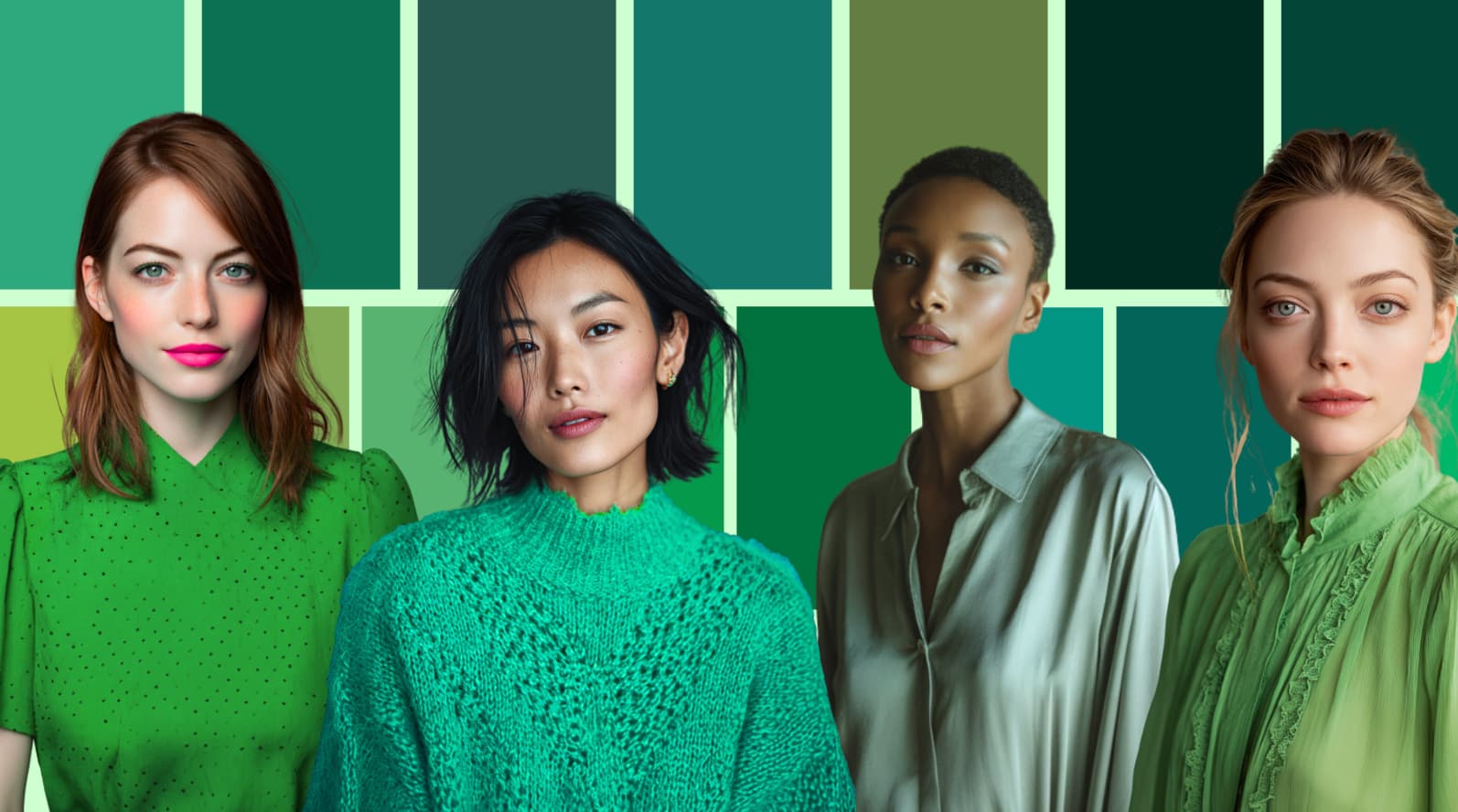
Color analysis has completely changed how we think about our clothing and how color interacts with our face, mood, and presence. It explains why that one olive sweater you bought online makes you look a little tired… while another green blouse from a thrift bin makes your whole expression lift. It seems like magic, or a hoax, until you understand the theory and practices behind it.
After seeing many clients for color services, I can safely say that most people love their blues, and the second most loved color is green. This makes sense, right? Typically, blues and greens are colors a lot of people wear, and they have a wide flexibility in clothing and within the 12 seasonal color palettes. The yellows and purples are much trickier to find a color that looks “ok” on you. But the question comes up with greens, is how can I tell what green is MY green? They show up warm, cool, muted, bright, earthy, fresh, crisp, soft, or jewel-like. And because green often sits right on the warm/cool boundary, our eyes can get confused about what works, what clashes, and what supports our undertones.
Each season in the 12-seasonal system has its own distinctive range of greens, from icy, crystalline blue-greens in True Winter to rich, earthy olives in Dark Autumn. These greens- YOUR greens- help define your features, brighten your complexion, and create a support system for your best look. You are in harmony. If you’re not sure what a “good” and “bad” color does to you, check out this article where I go through my season (bright spring) and a commonly guessed season (true autumn).
To help you learn your palette more deeply (and avoid the “why does this green betray me?” spiral), I’ve put together the best greens for each of the 12 seasonal color palettes. These greens were pulled directly from Sci\Art-aligned palettes- the same system I use in my color services-and will help you hone your eye and build confidence in your wardrobe.
This article is part of a series- you can find the other “Best Colors For Your Season” Articles here.
But first, the great debate!
We may earn a commission from you clicking a link below. And as an amazon associate, we earn on qualifying purchases. Full affiliate policy, here.
Is Green Warm or Cool?

This is one of the most common questions people have, and understandably so. Green is one of the only color families that genuinely straddles the warm/cool divide. That means:
- Some greens are unmistakably warm
- Some greens are unmistakably cool
- A huge number of greens sit in the “is this warm or cool??” middle
Technically, if we refer to color systems like Munsell and the traditional color wheel, we would classify green as a “cool” color. As visible by the black line dividing the color wheel above. However, in practice, it is a bit more nuanced than that. Green is composed of yellow and blue (which is how we warm up or cool down a color). Hence, in color analysis, I find it really does sit in that warm/cool divide. Every palette gets a good variety of greens (some warmed up, some cooled down, some lightened, and some with depth).
I think this is why many find green a more forgiving color, because it has fewer reactionary responses when it’s slightly off. I mean, the muted true autumn green wasn’t atrocious on me, but it certainly didn’t give me the lift and brightness of the bright spring green. (The heaviness in my face in true autumn though is NOT what we are going for here!)
Warm Greens
Warm greens can have:
- a noticeable yellow influence
- a mossy, olive, golden, or grassy quality
- warmth that feels sunlit or earthy
- softness or richness depending on the palette
You’ll see warm greens in:
Cool Greens
Cool greens can have:
- a blue undertone
- clarity or iciness
- oceanic or crystalline qualities
- brightness or muted softness, depending on the palette
You’ll see cool greens in:
What makes green tricky?
Green is created by mixing yellow + blue, and the ratio (plus depth + clarity) determines the color family. You don’t have to become a color expert to understand your palette, but sometimes understanding the basic color properties and how they relate to YOUR season, can help you spot them in the wild.
We can see above that greens can have a chroma scale as well (just like every color!). We see the pure pigment green (like those found in my season Bright Spring) slowly muted with touches of gray until they are in a soft autumn season.
Are the greens you are going to show me the only greens I get?
Absolutely not. These greens are representative samples, not the full extent of your palette. Your fan does not show you EVERY color you can possibly where, but rather the range of colors. For more information on how to use your fan, you can watch this video series.
Your fan is your guide, not a prison. You’re looking for a harmonizing relationship, not an exact match.
If you’d like to purchase an NDU seasonal color fan, the ones I give my clients, you can do so here and get a free color card using my code ARRUDA.
How can I tell if a green is in my palette?
The easiest way is to use a physical color fan.
When evaluating a green:
✅ You want it to “meet” your fan
It should neither disappear nor shout over your fan’s colors.
✅ It shouldn’t turn dull or overly yellow next to your fan
If it does, it’s probably from the wrong season.
✅ Don’t look for a perfect match
You’re looking for agreement, like two colors that can create a print or outfit seamlessly instead of creating a disjointed or novelty based pairing.
Below is your full per-season breakdown so you can begin building an intuitive relationship with your greens.
Seasonal Color Palettes: Your Best Greens
Dark Winter
Hue: Neutral/Cool
Value: Dark (low)
Chroma: Medium High
Dark Winter greens are deep, moody, and commanding. Think pine forest shadows, inky teal, midnight green, and cool, blackened jade. These greens have a crispness and a cool backbone, but they also carry enough neutrality to feel grounded rather than icy. That is their distinct autumn influence, they feel grounded and forest-like not artificial or frozen.
You can go surprisingly deep here without losing yourself- Dark Winter thrives in richness and contrast. The greens in this palette maintain clarity, even at their darkest, and they hold a slightly blue influence that stays loyal to the winter family’s coolness. They have a touch of autumn influence, which means they can lean slightly more toward our neutral greens as well.
You have a wide range: bright blue-greens for contrast, deep teals for sophistication, and dark emeralds that feel mysterious and powerful.
True Winter
Hue: Cool
Value: Medium
Chroma: Medium High
True Winter greens are icy, clear, and striking. Think frozen lake teal, crystalline emerald, bright turquoise, and cool blue-greens that look like you could chip them out of ice.
Winter’s cool undertone is uncompromising here. These greens must be:
- purely cool
- high clarity
- free of yellow
- crisp rather than soft
True Winter’s greens reflect the cold brilliance of winter light. They bring intensity without heaviness. They match your energy with commanding presence and a regal essence.
Bright Winter
Hue: Neutral/Cool
Value: Medium
Chroma: High
Bright Winter greens are dazzling, gemstone-like, and vibrant. Think high-chroma emerald, electric teal, vivid jade, bright crystalline aqua, and ice-bright turquoise.
These greens have a clarity that feels almost light-filled. They’re punchy and bold but never tropical. They echo the sharp, fresh intensity of a sunlit, snowy morning; think cool, brilliant, and high-energy.
You also have more neutral blue-greens for casual dressing, so you’re not confined to ultra-bright colors all the time. Every palette has a range to play with that includes neutrals, brights, darks, and lights! So if some of these greens surprise you, they are part of your palette. Don’t stereotype yourself into only neons and high-intensity brights!
Bright Spring
Hue: Neutral/Warm
Value: Medium
Chroma: High/Bright
Bright Spring greens are vibrant, sunny, and alive. Think tropical jade, bright leaf green, warm turquoise, and neon green. While you don’t have to wear a neon green, Bright Spring and Bright Winter are probably the seasons that can pull it off most easily. These greens sparkle- they’re energetic without being heavy, and warm without being muddy.
As a spring palette, these greens carry a subtle warmth, but Bright Spring keeps that warmth crisp and clear, never murky. You’ll see greens that are tropical, alive, and playful.
As a Bright Spring myself, I know firsthand how these greens shift a wardrobe from “fine” to “radiant.”
True Spring
Hue: Warm
Value: Medium
Chroma: Medium High
True Spring greens are unmistakably warm! They include fresh grass, yellow-tinted medium greens, clear warm jade, vibrant golden olive, and clear lime greens. These greens feel bright, energetic, and sunlit.
This is one of the palettes with the largest range of greens. True Spring gets:
- yellow greens
- warm blue-greens
- bright, fresh spring greens
- clear turquoise
- warm emerald-like shades
- lighter and darker variations
There is no heaviness in this palette, it always has a freshly lit energy. However, you will notice your range is expansive and gives your more professional greens, casual greens, and “spotlight on me, please” greens.
Light Spring
Hue: Neutral/Warm
Value: Light (high)
Chroma: Medium
Light Spring greens are soft, airy, and fresh. Think mint, light jade, pale apple green, soft golden green, and clear-but-light aqua. These colors reflect the gentle brightness of early spring—sunlit, crisp, and buoyant. They seem to float with warmth and gentleness.
Light Spring greens always retain warmth, but they are lighter and more delicate than True or Bright Spring. They don’t overpower; instead, they lift. These greens feel translucent, light, and hopeful.
Light Summer
Hue: Neutral/Cool
Value: Light (high)
Chroma: Medium
Light Summer greens are cool, gentle, and ethereal. Think seafoam, eucalyptus, soft aqua, misty mint, and cool pastel green. These greens hold a soft coolness with an airy clarity.
Light Summer greens evoke coastal mornings, foggy waterlines, and dappled light through pale leaves. They feel serene, whisper-soft, and quietly bright. However, this is another season that can get stereotyped to only having light platinum hair and soft pastels. Light Summer can absolutely have ashy brunette hair and even cinnamon tinted cool hair. Their palette also has a wide range of vibrant tones that do not feel like “pastels”.
True Summer
Hue: Cool
Value: Medium
Chroma: Medium
True Summer greens are cool, muted, and softly elegant. Think dusty teal, subdued blue-green, cool eucalyptus, gray-mint, and soft lagoon green. They would be at home in an English Garden for tea.
These greens feel like still water under cloud cover. They are calm, cool, and refined. They never skew warm and always retain the signature Summer softness, even in medium values. They have a more delicate air than the True Winter greens.
Soft Summer
Hue: Neutral/Cool
Value: Medium
Chroma: Soft/Muted (low)
Soft Summer greens are muted, velvety, and introspective. Think sage, dusty eucalyptus, muted teal, smoky green, soft moss, and grayed leaf green.
There is a tender subtlety to these greens. They reflect muted forests, fog settling over foliage, and the quiet distance of a shaded woodland stream. These greens are gentle, grounded, and enchanting. Their softness is their strength and they pair beautifully with softer fabrics that match their lighter energy.
Soft Autumn
Hue: Neutral/Warm
Value: Medium
Chroma: Soft/Muted (low)
Soft Autumn greens are warm, muted, and earthy. Think sage, soft olive, moss, muted jade, weathered green, and dusty golden greens.
These greens feel grounded and cozy, like sunlit grass at the end of summer or lichen on stone. They have warmth, but it’s softened by neutrality. But do not mistake the “soft” quality for being all delicate, lighter colors. There are some beautiful, moody greens and darker greens within this palette that create a grounded strength to the palette.
True Autumn
Hue: Warm
Value: Medium
Chroma: Medium
True Autumn greens are rich, golden, and robust. Think deep olive, warm moss, golden green, muted warm emerald, forest pond green, and harvest greens. Greens in the forest during Autumn season is a perfect inspiration for your greens.
These greens carry a grounded, earthy warmth. They echo autumn landscapes like turning leaves, deep shadows, and weathered wood. They’re timeless, comforting, and incredibly flattering for warm undertones. They feel more grounded and weathered than the True Spring greens. Where true spring leaf green is fresh cut in April, True Autumn green is that leaf just before it falls in October.
Dark Autumn
Hue: Neutral/Warm
Value: Dark (low)
Chroma: Medium High
Dark Autumn greens are deep, complex, and dramatic. Think dark olive, blackened teal, moody forest green, deep bottle green, and rich golden green. They border Winter so they have some cool influence, which is why some of these greens may “almost” feel like Dark Winter pines.
These greens have warmth, but it’s layered with depth and mystery. They feel like twilight settling over an autumn forest. They are dynamic and the brightest of the autumn family.
Again, to break any stereotypes, remember that you also get lighter greens!
I truly believe that determining your seasonal color palette can be a massively transformative aspect of your quest for an authentic personal style. Whether you enjoy dressing in harmony or not, understanding what “works” so you can either use or break those rules opens up new possibilities for your coloring and style.
Do I always abide strictly by my Bright Spring Palette? Nope. I wear true black and I often have a wide flexibility for my reds since they are my favorite color. But, investing in pieces, special events, and general shopping is heavily influenced by my palette understanding. It also creates a tier for my A+ pieces and guides me to smarter shopping choices and “easy yes” pieces.
Understanding your seasonal color greens is just one step to honing your eye for color and understanding what supports your natural features.
This can help you find strength through style.
What color would you like to see next?
Can you do yellow or orange next? Thanks!
Will work on those!
You are over there sparking creativity over here. I love seeing both the palette that is my best but also the cousin palette(s) that I tend to pull from when summer hits and I’m drawn to clearer favorites.
Delicious!