
Style Complexity: How Much Design Can You Handle?
Imagine standing in a quiet garden just after dawn. The light is soft, the leaves shimmer with a delicate layering of color and shape, and the air hums with an energy that is neither rushed nor still. Everything you see – the textured bark of the trees, the intricate patterns of light on the ground, the movement of the flowers in the breeze – is a symphony of complexity that feels both natural and inevitable.
This is the language of texture and complexity in personal style.

Previously, we explored how your natural textures — the qualities of your skin, hair, and facial features — can guide you toward fabrics and surfaces that either harmonize with or artfully contrast who you are. If you haven’t yet explored that foundation, don’t worry — today’s journey will stand beautifully on its own. But if the ideas here resonate, you may find even deeper clarity by revisiting that first exploration into the world of texture, here.
Today, we open a new door: complexity.
Because once you’ve learned to feel the textures of your natural design, the next step is understanding how much design you can wear — and still remain completely, effortlessly yourself.
If you’ve ever put on an outfit that was a perfect match to your style toolbox but looked at your daily outfit photo in shock because… well, you just disappear behind the look, this is the answer! {assuming you’re looking for an answer 😉 }
Texture Was Only the Beginning— Now, Style Complexity is in the Mix
When we first think about “texture,” we often imagine it literally: the roughness of tweed, the slickness of satin. But texture also carries visual weight. It’s the feeling of surface interest — how the eye travels over your face, your skin, your hair, and ultimately, your clothing. Fabrics have textures, as do your features.
You can see above that the fabrics/textures move from light to heavy. Starting with airy chiffons, organzas, moving to silks, polished cottons, clean wools, and then transitioning to nubby knits, embroideries, heavy silks, brocades, velvets and finally to vinyl, leather, and suede.
Now, style complexity asks a deeper question: how much design energy do you naturally carry — and how much should your clothes echo back?
Complexity refers to the amount of visual detail, layering, movement, and surface interest that feels naturally harmonious on you. It’s not simply about “busy” clothes or elaborate outfits — it’s about how much “story” your clothing can tell without overwhelming you or dulling your presence.
If we look at the style complexity above we can see how the visual interest points and focal points increase as we move from low (very little if any) to high (tons of visual and design complexity). Understanding what your natural facial features and effect are can translate to how much design complexity you can naturally handle.
In a way, this mirrors ideas found in systems like Kitchener’s Essence theory, where a person’s energy, movement, and features influence the best designs for them. While this isn’t a direct application of that system, the principle is similar: understanding your innate energy allows you to choose design elements that enhance your authenticity, rather than fighting against it. And while the examples I give are not meant to mirror Kitchener’s verified celebrities (at all!), you may find overlap.
Mother Nature is our perfect model. A peaceful meadow isn’t chaotic, but it isn’t flat either. There’s variation — a soft ripple in the grass, the jaggedness of a distant tree line, the dance of light across a pond. When you dress, you’re recreating your own natural “landscape” through design: the right mix of movement, contrast, detail, and simplicity that matches your inner energy.
Is it just an individual garment?
So far, many of the examples in this article have focused on dresses to make visual complexity easier to isolate and understand. Dresses provide a simple canvas to see how design elements — like seams, structure, layering, and movement — build complexity.
However, in real-world styling, design complexity is rarely contained to a single garment. It often emerges from the full outfit: the interplay of textures, the layering of accessories, the addition of jackets, scarves, jewelry, and even shoes. Complexity lives not just within a dress, but across the entire silhouette you create.
Here is an example using style complexity with the full outfit (including accessories).
And you can have low complexity pieces paired in a way that read together as “high complexity”- like this:
How Complexity Shows Up In You
To understand your natural complexity, look at yourself beyond just your skin and hair. While we will get into possible skin and hair combinations shortly, it’s important to take the full picture in consideration.
Your natural complexity shows not just in how you look, but how you move, speak, and express emotion. Some individuals carry stillness like a quiet lake; others spark and flow with constant energy. Clothing that mirrors this energy makes your presence feel effortless and magnetic.
Notice:
- How you move — Are your gestures small and deliberate, or do you move with full-bodied animation?
- How you speak — Is your voice soft and steady, or lively and expressive?
- How you engage — Are your facial features still, or do you smile wide, lift your eyebrows, and talk with your whole face?
These signals tell us how much “visual energy” your clothes should reflect. If you are a calm river, your clothing should not look like a churning storm. If you are a crackling bonfire, a plain linen dress may dampen your flame.
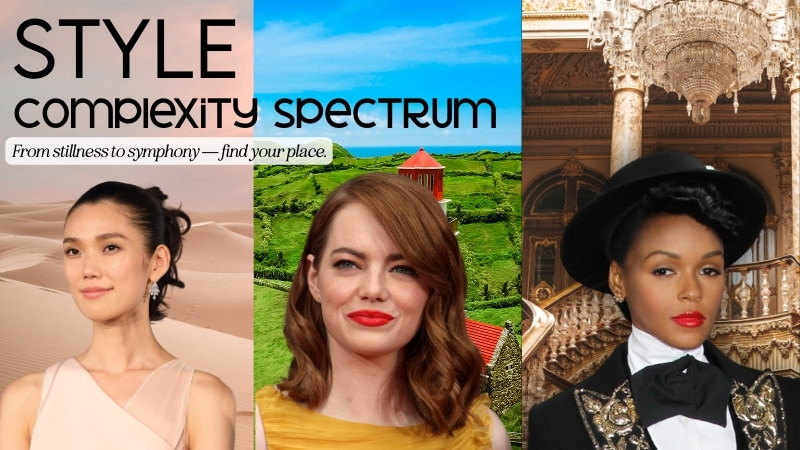
Sofia Coppola’s soft expression and simple gown mirror the calm stillness of the lake beside her. Both evoke a sense of quiet, uncluttered elegance — where nothing feels rushed or excessive. This is a great example of low complexity both in features, demeanor, and clothing.
Emma Stone’s movement and expression have rhythm and charm, just like the garden path — structured, but alive. There’s flow, contrast, and detail, but always with balance. This represents medium complexity.
Janelle Monáe’s dynamic presence and layered styling echo the vibrant, architectural intensity of the NYC skyline. There’s no stillness here — only texture, expression, and visual electricity. The eye delights in this high complexity match between clothing, features, stance, and presence.
Examine a few random videos of mine. We can see that I am medium style-complexity. I am animated, yet stable. I read as energetic but not necessarily powerful or extreme. I speak with my hands but they are somewhat controlled. I have expressive facial movements. My face and body read as lively but not like a thunderstorm rolling over the mountain.
Texture and complexity work together. Texture provides the “feel” of the surface — smooth, medium, rugged. Complexity governs how much variation, layering, and movement you can wear within those surfaces.
Does Seasonal Color Play Into This?
While seasonal color analysis helps us identify which hues harmonize with our natural coloring, it doesn’t define the full story of how we wear those colors. It tells us what to wear in terms of pigment — not how those colors should be expressed through texture, layering, or design detail.
There are general texture suggestions within each palette, but the level of complexity you bring to an outfit — whether it’s streamlined or richly layered — is shaped by your own unique visual energy.
Two Winters might both wear a saturated black gown. One might shine in a sleek, minimalist silhouette (low complexity), while the other commands presence in an intricately constructed velvet dress (high complexity). Likewise, two Light Summers might choose from the same soft, airy palette, but one may favor gauzy chiffon while another leans into structured linen or suede.
Take Jennifer Connelly and Janelle Monáe — both likely Winters. Jennifer often shines in structured, minimal silhouettes with clean lines and a cool stillness that suits low to medium complexity. Janelle, by contrast, embraces bold design contrast, layered texture, and animated expression — a true example of high complexity. Same season, entirely different style equations.
Understanding your seasonal palette is only part of the equation. Wearing your colors in a way that reflects your personal texture and complexity is what makes them come alive.
The Three Lanes of Texture Complexity
Low Complexity
Visualizing Low Complexity in Style
Picture a still, glassy lake under a pale morning sky — smooth, serene, with only the softest ripples across its surface. This is the feeling low complexity individuals naturally evoke, and their clothing should reflect this same calm refinement. Style lines for low complexity are simple and uninterrupted: clean, straight seams, gentle curves, and minimal detailing. Think of column dresses, classic blazers with minimal stitching, or trousers that fall in a single unbroken line. Shapes are uncomplicated: slight tailoring at the waist rather than exaggerated cinching, smooth column shapes or soft a-lines instead of intricate pleating. Textures remain polished and pure — opt for sleek silks, crisp cottons, fine merino wools, and supple leathers without excessive grain. Surfaces should appear mostly uniform, catching the light evenly without complex weaves or embellishments. Accessories are pared back to essentials: a single sculptural ring, a structured handbag, a whisper-thin belt. In this simplicity, low complexity individuals are not diminished — they are distilled to their most powerful essence, radiating quiet authority without ever raising their voice.
Low Complexity A still, glassy lake at dawn, a wide-open snowy field, an untouched desert plain, a calm misty morning, a smooth marble floor, a blank canvas
- Physical Cues: Smooth hair, skin of a single even tone, small, consistent facial features, minimal facial movement.
- Energy Cues: Quiet voice, slower walk, minimal gestures. Austere, patient, composed
- Ideal Design: Smooth fabrics (silk, satin, gabardine), minimal patterns, solid colors, simple accessories.
What You Might Wear:
- A sleek silk blouse paired with finely tailored trousers.
- A simple sheath dress with minimal seaming details
- Minimal jewelry: perhaps a delicate gold chain or a single pair of pearl studs.
- Shoes and handbags with smooth, polished finishes.
Think: Cate Blanchett’s elegant simplicity. The whisper of silk against the skin. A single pearl earring.
Low Complexity Celebrities:
- Cate Blanchett
- Tilda Swinton
- Rooney Mara
- Michelle Williams ( may lean low to medium)
- Gwyneth Paltrow
- Evan Rachel Wood
- Meghan Markle (low to medium)
- Tao Okamoto
(Fine to medium hair, smooth to translucent skin, minimal facial animation, calm presence — suits clean, flowing, simple design.)
Medium Complexity
Visualizing Medium Complexity in Style
Imagine a garden path just after a rainstorm — the air alive with texture, soft movement in every leaf, but with a clear and inviting direction. This is the landscape of medium complexity individuals. Their clothing should reflect a gentle interplay between simplicity and interest. Style lines are still clean but have slight shifts and gentle undulations: a softly curved neckline, a bias-cut skirt, a wrap silhouette that folds naturally over the body. Shapes maintain clarity but allow for subtle variation — a nipped-in waist, a soft drape at the shoulder, a cuffed sleeve. They are a set number of focal points. Textures are moderately detailed: breathable linens with visible weave, piqué cottons, suede, brushed twill. These surfaces invite a closer look without overwhelming the eye. Medium complexity wearers can comfortably balance a few details: a lightly printed blouse under a structured blazer, a tonal mix of textures like matte leather with crisp poplin. Accessories are layered with intent- a slim gold chain paired with a fine leather watch, a woven handbag rather than a smooth one. Their style dances between calmness and vitality, always offering enough intrigue to draw you in, but never so much that it feels chaotic.
Medium Complexity: A garden path after a rainstorm, gentle rolling hills, a lightly rippled ocean bay, a dappled forest glade, a cobblestone street, a breeze moving through wheat fields
- Physical Cues: Wavy hair, slight tonal variation in skin and hair, features with some variation in size, moderate facial movement.
- Energy Cues: Medium speaking volume, walking with steady purpose, gestures that punctuate conversation. Slightly animated but not overwhelming, magnetic, and can feel like a long lost friend.
- Ideal Design: Slight surface interest (linen, piqué, suede, light embroidery), simple prints, coordinated accessories.
What You Might Wear:
- A softly textured linen blazer over a cotton blouse.
- Medium-scale prints: a floral blouse, a softly checked skirt.
- Jewelry that adds detail but doesn’t overwhelm: a layered necklace set, or a stack of slim bangles.
- Medium-grain leather accessories that add tactile richness without shouting.
Think: Emma Stone’s radiant elegance in a sunlit yellow gown — structured yet flowing, adorned with a single statement necklace. A look that balances simplicity with a touch of drama, perfectly embodying medium complexity.
Medium Complexity Celebrities
- Emma Stone
- Jourdan Dunn (low to medium)
- Natalie Portman
- Anne Hathaway
- Florence Pugh (medium to high)
- Jennifer Aniston
- Ayo Edebiri
(Medium hair thickness, moderate skin opacity, some facial animation, steady but expressive presence — suits a little more texture, medium-scale prints, gentle layering.)
High Complexity
Visualizing High Complexity in Style
Now picture a dense, sun-drenched forest — everywhere you look, there is movement, texture, color, and life layered upon life. Or imagine a bustling coral reef, a woven tapestry shimmering in shifting light, a crowded flower market bursting with layers of color and fragrance. Or a New York city skyline, a cornucopia of texture, shape, and interest. This is the spirit of high complexity individuals. Their clothing thrives on richness, variation, and a dynamic sense of life.
High complexity isn’t limited to ruggedness. It can be expressed through textural richness, ornate detailing, avant-garde structure, or architectural layering — always offering visual depth that invites the eye to travel. I would say there are (at least) two forms of high complexity, one that leans more rugged/textural/artsy, and one that leans more avant garde/over the top. They are two sides to the same coin.
Style lines are intricate and expressive — asymmetrical cuts, visible seaming, pleats, gathers, draping, and layered construction. Designs may feature multiple seams, sculptural tailoring, or flowing movement that shifts as the wearer moves.
Shapes are lively and abundant — flared skirts, balloon sleeves, cascading lapels, gathered waists, unexpected proportions that create visual rhythm. Their outfits feel layered and rich with details/focal points.
Textures are vivid and tactile — bouclé, heavy knits, raw silks, mohair, embroidery, velvet, brocade. Surfaces may combine matte with shine, smoothness with grain, softness with structure within a single outfit.
High complexity individuals are uniquely able to layer patterns, colors, and materials — a printed scarf over a structured jacket, jewelry that clinks and catches the light, bags with braiding, embellishments, metallic threads — and still maintain visual harmony.
Their style calls for clothes that move, sparkle, shift, and surprise — garments that mirror their animated, richly textured spirit without ever drowning it.
High Complexity Visual Landscapes:
A dense sunlit forest, a crowded flower market, a wild mountain cliff face, a bustling coral reef, a woven tapestry, a roaring river through a rocky canyon, the bustling skyline of NYC
Physical Cues:
- Curly, wavy, or highly textured hair ( To be CLEAR! This does not place african americans with natural hair texture into high complexity, there is range for hair texture within each spectrum of hair types, and one feature would not dictate your complexity)
- Hair with lots of volume and ability to handle drama/large shapes
- Skin with visible tonal variation — freckles, ruddiness, rich opacity
- Dramatic, animated facial expressions and vivid facial movement
- A powerful or grounded look to features or presence
Energy Cues:
- Expressive gestures; high complexity people often use their face, hands, and body
- Compelling speakers; you tend to listen to them as they speak.
- Dynamic Visual Presence
- They feel like strong mountains, skyscrapers, or a dense forest. They command power with their glance, or appear reliable and self assured.
Ideal Design Elements for High Complexity:
- Heavily textured fabrics (bouclé, mohair, raw silk, velvet, embroidery)
- Rich all-over prints or complex layering of solids
- Avant-garde tailoring, structural draping, asymmetry
- Layered accessories: multiple earrings, stacked rings, scarves, ornate belts
What You Might Wear:
- A textured jacket (like tweed or bouclé) layered over a patterned blouse with lively, artistic jewelry.
- Highly complex can show up in playful/animated looks, intense/dramatic looks, or even in boho looks! It is not “one style”
- Skirts or trousers made of visible weaves, crinkled silk, velvet, or richly detailed brocade.
- Architectural pieces — sculptural coats, asymmetrical dresses, draped blouses with visible movement.
- Bags and shoes that feature embellishment, embroidery, braiding, metallic accents, or mixed textures.
High Complexity Celebrity Examples:
- Zendaya (probably medium to high complexity)
- Janelle Monáe (consistent high complexity through structure, texture, and bold layering)
- Helena Bonham Carter (expressive layering, asymmetry, rich textures)
- Tessa Thompson (bold structure, architectural pieces, layered fabrics)
- Lady Gaga (when styled with surrealism and elaborate construction especially)
- Solange Knowles (avant-garde layering, mixed textures, and striking silhouettes)
- Florence Welch ( medium to high, leans more on the “rugged” side of high)
- Rina Sawayama ( expressive and dynamic styling)
(All carry visual richness, dynamic expression, and a strong ability to balance surface interest, structure, and layered design without being overwhelmed.)
Note:
While “rugged” textures like boucle, tweed, or raw silk often flatter high complexity individuals, high complexity is not about ruggedness alone. It can also be polished, surreal, ornate, or conceptual. The common thread is visual depth, dynamic layering, and richness of detail that matches the wearer’s natural animation and presence.
Sidebar: What If You’re Between Medium and High Complexity?
Not everyone fits neatly into a single complexity lane — and that’s not only normal, it’s beautiful. I want you to view it more as a spectrum. And if you want to really deep dive into it you can find your general range and how you use each complexity for life events/style needs.
You might find that while your everyday presence feels medium complexity — calm but expressive — you come alive in more layered, richly detailed styling for special occasions.
Signs you might live between Medium and High Complexity:
- You feel comfortable in softly textured everyday fabrics (like linen or suede) but crave deeper textures (like velvet or jacquard) for events.
- You can handle a single bold print or a pop of asymmetry without feeling overwhelmed.
- You enjoy layering jewelry or combining textures when you want to feel “more yourself” but prefer it in a slightly more edited way than full high complexity styling.
How to Dress for This Hybrid:
- Start with a clean, medium-weight base (like a structured jacket or simple dress) and add one or two pieces of high complexity: a richly textured scarf, a standout pair of earrings, or a skirt with structural draping.
- Let one textured or complex item “lead” the outfit rather than layering texture on texture endlessly.
- Trust your eye — if your outfit feels alive but not chaotic, you’re in the right zone.
- I like to suggest starting with a baseline of “medium complexity” and slowly adding in elements of high, paying attention to when it tips to “too many” focal points.
Examples of “Medium-High Complexity” Celebrities:
- Lupita Nyong’o ( handles boldness but can’t overdo details)
- Florence Pugh (balances sculptural designs with fresh, youthful energy)
- Harry Styles (in editorial or stage outfits, mixes rich layers with striking simplicity but appears more “in costume” when he goes full high complexity)
Remember: Complexity isn’t a cage. It’s a palette. Some days you’ll want more stillness. Other days, you’ll want the full wild garden. But we want to generally find your complexity “boundaries” so you not how to effectively use them!
Recreating Your Natural Design
Your job isn’t to “correct” your features or “fix” your textures.
Your job is to tell the truth with your clothing.
If your hair carries a thousand waves, let your clothes echo it with textured fabrics, rhythmic prints, or layered accessories. If your skin is smooth and still, let your clothing mirror that serenity with clean lines and simple surfaces.
When you match the internal energy to the external presentation, you create harmony so profound that others can’t help but notice — even if they can’t articulate why.
Style Complexity ≠ Aesthetic
Your complexity level doesn’t dictate your aesthetic — it’s a tool to help you refine how your personal style vision is expressed. Whether your style leans boho, romantic, minimalist, or edgy, understanding your ideal complexity range helps you choose how much visual information your outfit should carry to feel aligned, not overwhelmed. the feeling of standing in that garden at dawn again. Everything fits.
Low Style-Complexity Variations
This collage blends aesthetics like minimalist chic, modern classic, refined romantic, and tonal tailoring — all grounded in clean lines and subtle textures. There are a million ways to take low style complexity needs and apply it to an aesthetic or personal style desire. So don’t feel like there is “one right way”.
Medium Style-Complexity Variations
Here we see aesthetics such as preppy modern, coastal polish, soft vintage, retro gamine, and grounded boho — each adding personality while staying visually balanced. But again if you want you could still be “maximalist” and apply medium style complexity. Or classic and be medium-style complexity. This is an overall design principle NOT your style vision.
High Style-Complexity Variations
A mix of eclectic maximalism, rococo romantic, edgy glam, and artistic avant-garde — this collage shows how visual depth and decoration define high complexity styling, but shows it’s not just one “look”. But you could also opt for a more refined, quiet luxury look with high style complexity. You’re just adding in larger focal points or more singular, sculptural elements.
I do plan to do a video {soon} on how style complexity, outfit rhtyhm, and textures all work together. So if you have any questions or requests, let me know in the comments!
Does this mean I my fabrics are limited?
NO! Your style complexity does not necesasrily preclude you from any fabric weights or textures.
You can see above that there can be light textures that have high complexity and heavy textures that also have high. It’s a spectrum, and a visual tool!
Even certain fabrics, within their range can lean light to heavy. For instance leather can have low complexity or high complexity in both texture and outfit.
The same would go for any type of fabric!
How to Discover Your Texture Complexity
Take a quiet afternoon and observe yourself. Better yet, record yourself speaking casually and watch it back. Or even ask friends or in a facebook group like mine.
- Do your hands move often? (Hint: You may have more complexity than you think.)
- Does your face light up, shift, and animate when you tell a story?
- Do you prefer giving short, factual answers — or long, detailed ones?
- How do you people interpret you? What is their first impression of you? Be specific a low complexity person can come off reserved, but a high complexity person might seem intimidating, but a person with a casual first impression might just say both are “aloof”.
There’s no “better” category. There’s only yours.
When I watch my videos or look back on my daily outfit photos and take notice of my mannerisms and animation, I can clearly see that I am medium complexity. I can’t handle the fully rugged or architectural elements a truly high complex person can, but I also don’t thrive in the smooth, clean lines of the low complexity. My sweet spot is animated yet focused. I need some textural interest, but a clear focus for my unusual details, textures, or focal points.
Another tip: Look at the outfits you already love most. Are they simple and serene, lightly detailed, or richly layered? Often, your closet holds the clues to your complexity even before your mind fully catches up.
Practical Examples
If you are smooth/low complexity:
- Build a wardrobe of clean, flowing fabrics.
- Choose smooth fabrics, fine knits, and polished jewelry.
- Keep prints minimal or absent.
- Limit yourself to one statement piece at a time — a single focal point coat or a refined dress.
- Consider smooth, fluid outfit rhythm
If you are medium complexity:
- Mix smooth and lightly textured fabrics.
- Introduce some variation: a tweed jacket over a soft cotton dress.
- Choose subtle or softly layered accessories. But make sure you don’t have an overwhelming amount of focal points in an outfit.
- Incorporate medium-scale prints like light plaids, subtle florals, or interesting patterns.
- Consider upbeat, waltz, or medium tempo outfit rhythm
If you are rugged/high complexity:
- Celebrate rich textures and lively prints.
- Layer necklaces, rings, scarves with freedom.
- Combine patterns carefully, letting your natural energy hold them together.
- Embrace complexity in construction too — ruffles, draping, piecing, and asymmetry often look powerful on high-complexity individuals.
- If you lean more sculptural over rugged, go full avante grade!
- Consider full orchestra Vivaldi style outfit rhythm, each focal point should pack a punch!
Considerations: Something to Ponder
Sometimes, people dress opposite to their true nature.
- The dynamic, animated woman who hides in beige solids because she “doesn’t want to be too much.”
- The serene, steady soul who piles on busy patterns that obfuscate her presence instead of supporting it.
This is totally ok! It’s called dressing with style contrast, or using style to create a certain effect. It is also important to think about your style goals and what your process is for getting dressed. Rita’s Style Keys is a great approach to hone this down.
The goal of learning your innate style complexity, is so that you make an intentional choice in dressing. If you want to learn more about style harmony versus style contrast, check out this article here.
True style is not about trends or aesthetics or having a huge closet. It’s about telling the truth without speaking a word, and you are the author!
Final Thoughts
The more you understand your natural design, the more you can honor it in what you wear. Complexity is not “busyness.” Smoothness is not “plainness.”
Both are beautiful.
Style is not a costume. It is a landscape you offer to the world: a place to meet you, to understand you, and to remember you.
Whether you are a serene river, a shifting breeze, or a crackling fire, your clothes can become the reflection of your truest self.
And when they do, they don’t just clothe you — they speak for you.
P.S. If you loved today’s exploration, you might find even more clarity by visiting Part 1 of this series, where we explored the foundations of texture and how to match fabrics to your natural physical design. Together, these ideas create the full architecture of authentic style.
Note
This image was inspired by an image from The Triumph of Individual Style by Carla Mason Mathis and Helen Villa Conor page 153.
Oooo, I like this take Gabrielle!
I definitely feel more at home with harmony than discordance. And have been slowly pivoting to how that plays in my wardrobe creation.
I too find myself in-between the extremes, but layering in a subtropical environment still leaves me feels off for half the year!
I have recently discovered that woven tops feel much more me than knit tees. Though standard button-ups are too bland.
Seeking the sweet spot. 😉
Thank you Gabrielle!
I came upon your website after deciding to re-visit my coloring assessment (based on the classic “Color Me Beautiful” which I read in 1988 when I was 14). I’ve found out I’m still summer (hurray!) – now I need to make sure I know the exact variation… I enjoy reading your content and enjoy evaluating the people passing by in the high-street. Your content is eye-opening and I really enjoy it, many thanks!